How ProxyAdvice Compares Proxy Providers
Providers love big numbers: DataImpulse says 500,000+ customers chose it, and Proxy-Seller claims 185,000+ users. Popularity tells you what others bought, not what fits your volume. Here’s how ProxyAdvice compares proxy providers instead: the pages we read, what we record, how we score, and what we never do.
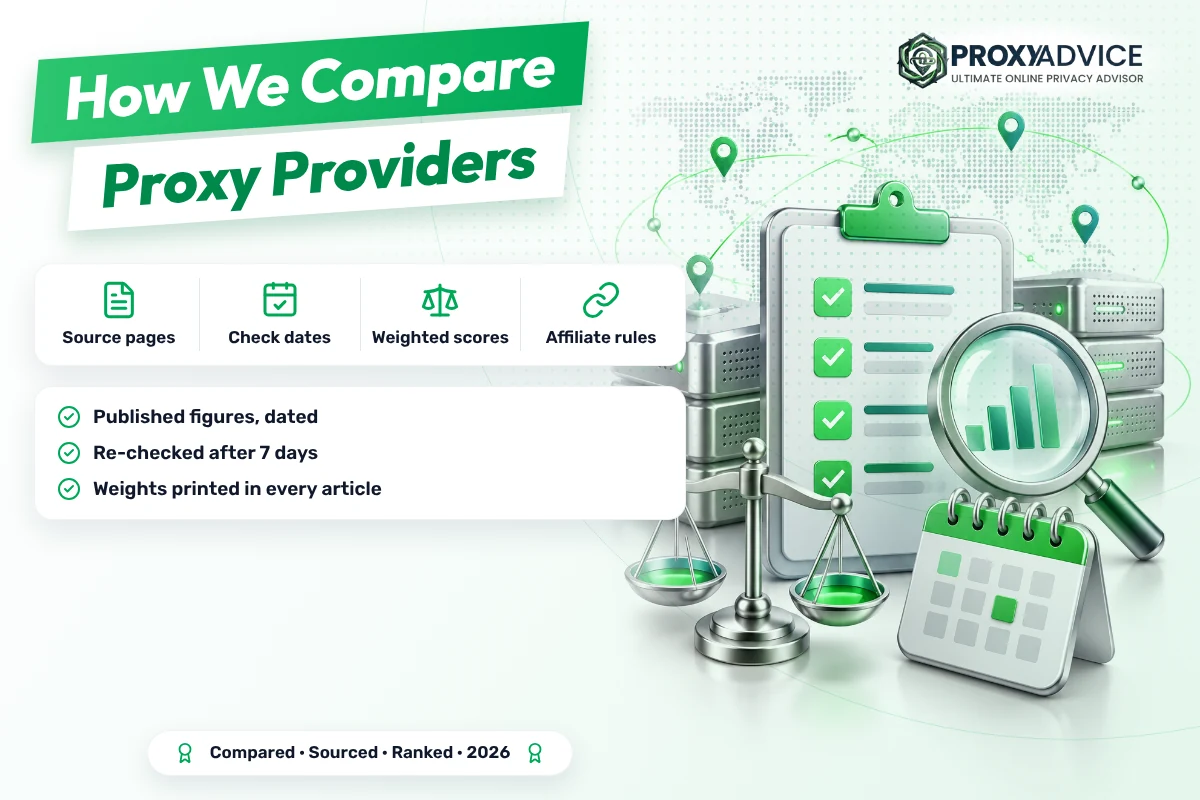
ProxyAdvice compares proxy providers by reading each provider’s own pricing and product pages, recording what they state with the date checked, and re-reading any figure older than 7 days before reuse. Scores out of 10 come from weights printed in each article. Every number is labelled as advertised, no figure is presented as a first-hand result, and affiliate status is not a scoring weight.
- Published figures only: prices, pool sizes, speeds and success rates come from each provider’s own page, labelled as advertised, with the date they were checked.
- Stated weights: every comparison prints its scoring weights, such as 35% for price, so you can redo the maths with your own priorities.
- Clear exclusions and links: excluded providers never appear in rankings, and affiliate links are marked and carry no weight in any score.
How ProxyAdvice compares proxy providers, step by step
Every comparison on this site starts from the same five steps, whatever the article type.
- Read the provider’s own pagesPricing pages, product pages and docs, read on a stated date. News articles use named outside sources instead.
- Record what they stateEach figure goes into one row of our Provider Facts sheet, with its source page and the date it was checked.
- Re-check old figuresAny fact older than 7 days is marked stale and re-read before an article can use it.
- Score with stated weightsEach article lists its weights in a method box. Scores out of 10 follow from those weights.
- Run the checksBefore publishing, an automated check rejects first-hand test claims, excluded providers, missing sources and unmarked affiliate links.
Want the rankings these steps produce? See all proxy rankings.
Which pages do we read, and what do we record?
One spreadsheet row per provider and product holds everything an article is allowed to say about it.
| Field | Example from the October 28, 2026 reading |
|---|---|
| Entry price | $1 per GB, DataImpulse residential |
| Plans and tiers | 3 GB for $11.25 down to $2 per GB at 1,000 GB, Decodo |
| Pool and countries | 175M+ IPs in 195 countries, Oxylabs |
| Advertised success and response | 99.92% and under 0.5 s, Decodo |
| Concurrency | Unlimited concurrent sessions, Oxylabs, Proxy-Seller and IPRoyal |
| Trial and refund | 3-day trial with 100MB and 14-day money-back, Decodo |
| Source page and date | The URL read and the day it was checked |
Examples are as advertised by each provider. Where a page is silent, the row says not listed.
When two pages from the same provider disagree, the article says so rather than picking one. Oxylabs, for example, lists 0.6 s and 0.41 s average response on the same page, and our proxy speed claims article shows both.
When are figures re-checked?
A price that’s two weeks old can already be wrong, because promos end without notice.
Our tooling marks any stored fact older than 7 days as stale, and an article can’t reuse it until the page is read again. Every article prints the date its figures were checked, and the residential proxy prices report gives a check date for each row.
How are scores weighted?
The weights change by article type, and each article prints the ones it used.
Each provider gets a sub-score from 0 to 10 on every weighted factor, based only on the recorded figures. The weighted sum, to one decimal, is the score shown. In our Bright Data alternatives ranking, price against the reference provider counted 35%, pool and locations 15%, entry terms 15%, advertised speed and success 15%, trial and refund 10%, and targeting and sessions 10%.
Scale changes the answer. At low volume, a $1 per GB plan with no subscription can beat everything; at scale, the tiers matter more, so we record each tier rather than the headline. Decodo’s from $2 per GB, for example, needs the 1,000 GB tier, and Oxylabs lists $2.50 from 1,000 GB against $6 up to 5 GB.
Enterprise-grade means something specific in our notes: a written SLA, a custom price and a named threshold, such as Bright Data’s 99.99% uptime SLA on Enterprise or Oxylabs’ Enterprise plans from $2,500 a month. When you need 10K concurrent sessions, the concurrency column is the one to read, and a page that’s silent stays not listed.
Every ranked provider has at least one real weakness in its cons, by rule.
How do we match providers to use cases?
A use-case tag has to come from a recorded fact, not from reputation.
| Provider | Fact behind the tag | Use-case tag |
|---|---|---|
| DataImpulse | $1 per GB, gigabytes never expire | Country-level scraping on a budget |
| Evomi | $0.49 per GB on 100 GB a month | High-volume, cost-first jobs |
| Decodo | 3-day trial, 3 GB entry plan | First-time buyers |
| Oxylabs | 175M+ IPs, $2.50 per GB from 1,000 GB | Large scraping jobs at volume |
| IPRoyal | Sticky sessions up to 7 days | Social media and account work |
| Proxy-Seller | Test plan, about 0.35 s advertised response | Short projects and quick tests |
| Bright Data | Country, state, city and ZIP targeting included | Precise geo-targeting |
Tags come from figures checked on October 28, 2026, as advertised by each provider.
Tags can change when the facts change. If a provider drops a trial or adds expiry to its traffic, the tag goes with it at the next re-check.
Which providers are left out, and why?
One provider is excluded from every ranking on this site today.
Its domains were seized by the FBI on 2 July 2026, so it’s marked excluded in our provider sheet and can’t be listed, linked or recommended in any comparison. The automated check fails any article that mentions it outside news coverage of the seizure itself.
Providers also drop out of a single article when no page confirms the figure that article needs. Our first SERP API ranking left SOAX out for that reason: no page we read confirmed a SERP API price.
How do affiliate links work here?
Some links on ProxyAdvice pay us a commission, and every article says so at the top.
Our partner sheet lists which providers have an affiliate link, currently including Proxy-Seller, IPRoyal, DataImpulse and Oxylabs. Those links carry a sponsored marker, and the check fails any article where an affiliate link lacks it. Coupon codes, such as Proxy-Seller’s GOTO15OFF, come from the same sheet and are shown as codes, not as part of the price.
Affiliate status isn’t one of the scoring weights. In the Bright Data alternatives ranking, three affiliate partners finished in the bottom half because their small-volume prices were higher. For individual reviews, see how we test.
What doesn’t this method do?
It doesn’t replace a test on your own targets.
- Comparison figures are what providers advertise. Real success rates on your sites can be lower.
- Prices can change between our check date and the day you buy.
- Pages that don’t publish a figure leave a gap that we mark as not listed rather than estimate.
To check a proxy yourself, you can test your proxies with GoToProxy or follow the 50-request test in our speed claims article.
FAQ
This page describes the process used for ProxyAdvice comparison, ranking and report articles as of October 29, 2026, including the 7-day re-check rule, the automated pre-publish checks and the partner sheet behind affiliate links. Examples come from figures checked on October 28, 2026. Compare our rankings with independent proxy ratings on ProxyRates.