7 Best SERP APIs in 2026 (Compared)
Here’s what the comparison grids leave out: the seven best SERP APIs don’t bill the same unit. Bright Data charges per request, Oxylabs per result, SerpApi per search and DataForSEO per SERP of 10 results. Read the unit before the price, or your cost model is wrong before your first call. ProxyAdvice earns a commission on some links here at no extra cost to you.
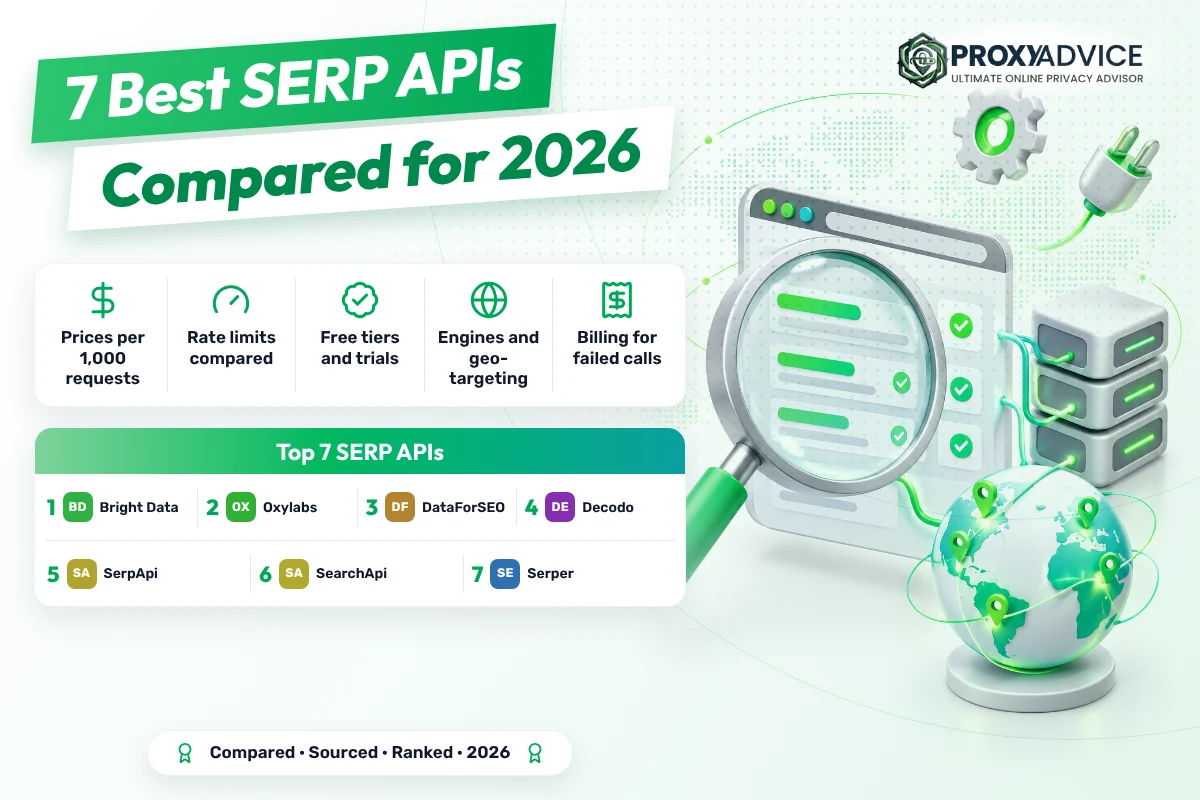
The best SERP APIs in 2026 are Bright Data, Oxylabs and DataForSEO. Bright Data lists 5K free requests a month and $1.50 per 1,000 after that, with no concurrency limit. Oxylabs charges $1.00 per 1,000 Google results at 50 requests per second. DataForSEO’s standard queue costs $0.60 per 1,000 if you can wait about five minutes.
- Read the unit first. Bright Data bills per request, Oxylabs per result, SerpApi per search and DataForSEO per SERP of 10 results. Headline prices aren’t comparable until you convert them.
- Limits decide scale. Oxylabs publishes 50 requests per second and Decodo 10 to 100. SerpApi caps searches per hour, and SearchApi allows 20% of plan credits each hour.
- Check what a failure costs. Most of the seven bill successful calls only, but Oxylabs counts 4xx responses as successful, so a bad parameter still costs you money.
What is a SERP API?
A SERP API is a paid endpoint that fetches a search engine results page (SERP) for you and returns it as data. You send a query, a location and a device. The provider handles the IPs, CAPTCHAs and parsing, then sends back JSON, HTML or Markdown. You’re billed per request, result or search.
You already know the basics, so here’s what matters at scale. Three things differ between vendors, and none of them show in a feature grid: the billing unit, the delivery mode and the published limit on how fast you can send.
Delivery comes in two shapes. Real-time (sync) keeps the connection open and answers in seconds. Queued (async) takes the job, works through it and hands results back later. DataForSEO prices the two very differently: $0.60 per 1,000 queued against $2.00 per 1,000 live.
Prefer to run your own scraper? Then you’re buying IPs, not an API. Start with our best residential proxies ranking, or the best datacenter proxies for lightly protected targets.
Short version: compare the unit, the queue and the limit before you compare the price.
Why pay for a SERP API when you could scrape Google yourself?
Because the hard part isn’t the request. It’s keeping thousands of requests an hour unblocked, localized and parsed while search layouts keep changing. A SERP API moves that work, and the cost of failed attempts, onto the vendor. You keep one bill tied to successful calls.
- Failures are their cost: Bright Data, Decodo, SerpApi and SearchApi all state that only successful requests or searches are billed. Retries stop eating your budget.
- Location is a parameter: Oxylabs lists country, state, city or coordinate targeting across 195 countries. You change one field instead of sourcing local IPs.
- Concurrency on demand: Bright Data says there’s no limit on concurrent requests. Oxylabs publishes 50 requests per second on paid plans. There’s no pool to size.
- Parsed output: Structured JSON arrives with organic and paid results separated. Bright Data and Decodo also return Markdown, which saves a cleaning step.
- Legal cover, sometimes: SerpApi lists a U.S. Legal Shield on every plan. SearchApi states up to $2M in coverage from its Production plan upward.
How do you size a SERP API before you commit?
Don’t start with the feature list. Start with your own numbers: queries per day, results per query, how many locations, and how fast results must come back. Then push a small real batch through a free allowance and read two figures: the cost per successful call and the calls you can send per second.
- Convert to one unitTurn every price into dollars per 1,000 SERPs at your depth. DataForSEO’s base covers 10 results, and 100 results cost $0.00465 on its standard queue.
- Use the free allowanceBright Data gives 5K requests a month, Serper 2,500 queries and Oxylabs up to 2,000 results, all with no card. SerpApi’s free plan covers 250 searches.
- Pin location and deviceSet country, city and desktop or mobile in every call. Defaults differ between vendors, and a wrong default quietly skews your rank data.
- Pick sync or queueDashboards and user-facing tools need real-time answers. Nightly rank tracking doesn’t, and a queue can cut the price by more than two thirds.
- Throttle to the published limitStay under the stated ceiling: 50 requests per second at Oxylabs, 200 searches an hour on SerpApi Starter, 20% of credits per hour at SearchApi.
- Log cost per successRecord status code, latency and billed units for each call. Divide spend by successful SERPs. That number, not the list price, is your rate.
The script below is vendor-neutral. Swap in the endpoint and auth scheme from your provider’s docs, since parameter names differ. It sends 20 calls in a row and prints how many returned a 200 and how long the batch took.
import time
import requests

API_URL = "https://API_HOST/API_PATH"
PARAMS = {"q": "running shoes", "location": "United States"}
HEADERS = {"Authorization": "Bearer API_KEY"}

ok = 0
start = time.time()
for _ in range(20):
    r = requests.get(API_URL, params=PARAMS, headers=HEADERS, timeout=30)
    ok += r.status_code == 200
elapsed = time.time() - start
print(f"{ok}/20 succeeded in {elapsed:.1f} s")Still running part of the pipeline on your own IPs? Static addresses from our best ISP proxies list suit signed-in sessions better than rotating ones, and they pair well with an API that handles the search pages.
Bottom of the sizing: one unit, one real batch, one cost per successful SERP.
Which are the best SERP APIs in 2026?

Bright Data wins on freedom to scale. Its SERP API page lists 5K free requests a month with no credit card, then $1.50 per 1,000 requests pay as you go, and says there’s no limit on concurrent requests. The catch: the same page states two different starting prices.
Run the numbers at volume. Pay as you go is $1.50 per 1,000 requests. The Scale plan is $499 a month with 380K requests included, which works out to about $1.31 per 1,000, and extra requests cost $1.30 per 1,000. Enterprise pricing is custom. The page says you pay only for successful requests.
Your first month can cost nothing. The free tier needs no card and renews monthly at 5K requests. You can set a monthly spend limit on pay as you go, and the page says Bright Data matches a first deposit dollar for dollar up to $500. Support is listed as 24/7. Payment methods appear only as an image, though AWS Marketplace is named.
Watch the fine print. The pricing menu says the SERP API starts from $1 per 1,000 requests, while the plan card says $1.50. The hero promises results in under 1 second, and the FAQ says under 5 seconds. Size your timeouts for the slower figure and confirm the rate in your dashboard before you commit.
- 7 engines named: Google, Bing, DuckDuckGo, Yandex, Baidu, Yahoo and Naver
- JSON, HTML or Markdown output
- 195 countries with city-level targeting
- 99.9% uptime SLA (advertised)
- Desktop or mobile user agents
- Bursty workloads with no fixed monthly volume
- Pipelines that want Markdown output without a cleaning step
- Teams that want a free tier that renews every month for staging
- 5K free requests a month, no credit card
- $1.50 per 1,000 requests with no monthly plan
- No limit on concurrent requests
- Pay only for successful requests
- The page lists both $1 and $1.50 as the starting price
- Two different response-time claims: under 1 second and under 5 seconds
- No requests-per-second figure and no refund terms on the page
| Plan | Price | Volume | Per 1,000 |
|---|---|---|---|
| Free tier | $0 | 5K a month | $0 |
| Pay as you go | $1.50 per 1,000 | Any amount | $1.50 |
| Scale | $499 a month | 380K included | About $1.31 |
| Scale overage | $1.30 per 1,000 | Above 380K | $1.30 |
| Enterprise | Custom | Custom | Not listed |
The page description mentions 50% off all plans, but the plan cards don’t repeat it. Baidu, Yahoo and Naver are in the FAQ’s list of 7 engines yet missing from the playground menu. Check both before you build.
Verdict: The most room to scale for the least commitment, as long as you confirm the real rate first. Read the full Bright Data review →

Oxylabs is the pick for steady Google volume. Its pricing page lists Google results without JavaScript (JS) rendering at $1.00 per 1,000 on the $49 Micro plan, falling to $0.80 on Advanced, with a limit of 50 requests per second on paid plans. The trade-off is a monthly plan from day one.
Three plans cover most teams: Micro at $49, Starter at $99 and Advanced at $249 a month. Google without JS rendering costs $1.00, $0.90 and $0.80 per 1,000 results. Other search engines cost $1.15, $1.10 and $0.95. Turn on JS rendering and every target costs $1.35, $1.30 or $1.25. The page adds that VAT may apply.
The first month starts with a free trial of up to 2,000 results, no credit card required, at 10 requests per second. Paid plans raise that to 50. The page lists 24/7 support and a dedicated account manager on all plans, and payments run through Stripe. Targeting goes down to state, city or coordinates across 195 countries.
Read the billing rule closely. Oxylabs says it doesn’t charge for attempts that fail with 5xx or 6xx codes, but anything returning 2xx or 4xx counts as successful. A bad parameter that triggers a 4xx is still billed. The SERP page also advertises a 6.04 second average response time, so this isn’t the fastest option here.
- Google, Baidu, Bing and Yandex named
- HTML or structured JSON output
- Country, state, city or coordinate targeting in 195 countries
- 50 requests per second on paid plans, 10 on trial
- Scheduler with delivery to Amazon S3, GCS and other S3-compatible storage
- Daily rank tracking on Google at a fixed volume
- Local SEO that needs coordinate-level results
- Teams that want an account manager from the first plan
- $1.00 per 1,000 Google results, $0.80 on Advanced
- 50 requests per second on every paid plan
- Coordinate-level targeting
- Free trial with no credit card
- No pay as you go: plans start at $49 a month
- 4xx responses are billed as successful
- 6.04 second advertised average response time
| Plan | Price | Volume | Per 1,000 |
|---|---|---|---|
| Free trial | $0 | Up to 2,000 results | Free |
| Micro | $49 a month | Up to 98,000 results | $1.00 (Google) |
| Starter | $99 a month | Up to 220,000 results | $0.90 (Google) |
| Advanced | $249 a month | Up to 622,500 results | $0.80 (Google) |
The ‘up to’ result counts assume the cheapest target on the page, which isn’t Google. Trial terms also differ between pages: the pricing page says up to 2,000 results, the SERP page says a $5 welcome credit.
Verdict: The best published rate for real-time Google results once you can commit to a monthly plan. Read the full Oxylabs review →
DataForSEO lists the lowest price of the seven: $0.0006 per SERP on the standard queue, or $0.60 per 1,000, with no monthly fee. You pay for that with time. Standard results arrive in about 5 minutes on average, and the live mode that answers in seconds works out to $2.00 per 1,000.
Three queues set the price. Standard is $0.0006 per SERP with a 5 minute average turnaround. Priority is $0.0012 and returns in up to 1 minute on average. Live is $0.002 and returns in up to 6 seconds on average. Per 1,000 SERPs that works out to $0.60, $1.20 and $2.00. The base price covers 10 results.
The first month is light on commitment. Registration credits $1 to your account, the minimum deposit is $50, and there’s no subscription. The page promises a 30-day refund on unused funds with no questions asked, and says money for failed requests goes straight back to your balance. It lists 99.95% uptime.
Depth is where budgets slip. The page prices 100 results at $0.00465 on the standard queue, nearly eight times the 10-result base, and warns that extra parameters may change the final cost. It doesn’t publish calls-per-minute limits either. Model your real depth and ask about limits before you load a million keywords.
- Google, Bing, Yahoo, Baidu, Naver, YouTube and Seznam
- JSON and HTML output
- Standard, Priority and Live queues
- $50 minimum deposit and no monthly fee
- 99.95% uptime (advertised)
- Nightly rank tracking across large keyword sets
- Agencies that bill clients per keyword
- Budgets that can’t carry a monthly plan
- $0.60 per 1,000 SERPs on the standard queue
- No subscription and a $1 trial credit
- 30-day refund on unused funds
- Failed requests refunded to your balance
- The cheapest queue takes about 5 minutes
- Live mode costs more than three times the standard rate
- Rate limits and geo-targeting detail aren’t on the pricing page
| Plan | Price | Volume | Per 1,000 |
|---|---|---|---|
| Standard queue | $0.0006 per SERP | 10 results, about 5 min | $0.60 |
| Priority queue | $0.0012 per SERP | 10 results, up to 1 min | $1.20 |
| Live mode | $0.002 per SERP | 10 results, up to 6 s | $2.00 |
| Standard, 100 results | $0.00465 per SERP | 100 results | $4.65 |
The price table isn’t labelled as Google-only, so treat these as general SERP prices. The page says cost doesn’t depend on the location parameter, but it doesn’t spell out how far down location targeting goes.
Verdict: The lowest listed price here, for jobs that don’t need the answer right now.

Decodo folds its SERP scraper into one Web Scraping API, so the same plan covers search pages and everything else. Plans run from $19 to $249 a month with 10 to 100 requests per second, and the page advertises a 99.99% success rate. It doesn’t publish a SERP-only price per 1,000.

Plans are sold by volume and speed. $19 a month gets 10 requests per second and up to 19K crawls or 38K pages scraped. $49 gets 25 requests per second, $99 gets 50 and $249 gets 100. The pricing index says the Web Scraping API starts from $0.09 per 1,000 requests. No SERP-specific rate appears.
The first month has two safety nets. The page offers a free starter plan and a 14-day money-back option, though it doesn’t state the conditions for either. Support is listed as 24/7 tech support with live chat, and a PayPal logo appears on the page. You also get 100+ ready-made templates, including Google, Bing, DuckDuckGo and Yandex.
Geo-targeting is the gap. The SERP page talks about precise geo-targeting but only confirms targeting by country. If you track rankings by city, verify that in the docs first. Output is the strong side: JSON, CSV, Markdown or HTML, plus PNG and XHR on some targets.
- Google, Bing, Yahoo and Baidu named, plus DuckDuckGo and Yandex templates
- JSON, CSV, Markdown, HTML, PNG or XHR output
- 10 to 100 requests per second, by plan
- 99.99% success rate (advertised)
- 100+ pre-built templates
- Teams scraping SERPs and product pages on one bill
- Pipelines that want CSV or Markdown without extra parsing
- Buyers who want a refund window
- Plans from $19 a month
- A per-second limit published for every plan
- Six output formats
- Pay for successful requests only
- No SERP-specific price per 1,000
- Only country-level targeting confirmed on the page
- Free plan and money-back conditions aren’t spelled out
| Plan | Price | Volume | Per 1,000 |
|---|---|---|---|
| $19 plan | $19 a month | Up to 19K crawls or 38K pages | Not listed |
| $49 plan | $49 a month | Up to 65K crawls or 122K pages | Not listed |
| $99 plan | $99 a month | Up to 141K crawls or 330K pages | Not listed |
| $249 plan | $249 a month | Up to 383K crawls | Not listed |
Decodo also sells a separate Fast Search API that the pricing index lists from $0.40 per 1,000 requests, with answers in under 1 second. That’s a different product from the SERP scraper described here.
Verdict: A sound choice when SERPs are one target among many, less so if you need a firm cost per search. Read the full Decodo review →
SerpApi is the expensive, low-risk choice. Every plan, including the free one with 250 searches a month, lists a U.S. Legal Shield, and only successful searches count. Paid plans run from $25 for 1,000 searches to $275 for 30,000, the highest price per search in this list.
Four paid tiers: Starter at $25 for 1,000 searches, Developer at $75 for 5,000, Production at $150 for 15,000 and Big Data at $275 for 30,000. That works out to $25, $15, $10 and about $9.17 per 1,000. Enterprise is quoted by sales. Cached, errored and failed searches aren’t counted.
The first month is easy to back out of. The free plan gives 250 searches, contracts run month to month, and you can upgrade, downgrade or cancel at any time. A full refund applies within 7 days of subscribing unless you’ve used more than 20% of your searches.
Throughput is capped per hour, not per second. The page lists 50 searches an hour on Free, 200 on Starter, 1,000 on Developer, 3,000 on Production and 6,000 on Big Data. A burst job that needs 30,000 searches in ten minutes won’t fit, whatever you pay for the month.
- Free plan: 250 searches a month
- U.S. Legal Shield listed on every plan
- Hourly throughput from 50 to 6,000 searches
- Uptime SLAs of up to 99.97% with Premium support
- API list names Google, Bing, Baidu, DuckDuckGo, Yahoo, Yandex and Naver
- Products where legal review decides the vendor
- Low-volume apps that need many engines
- Teams that want a cancel-anytime contract
- Legal Shield listed on every plan
- Only successful searches are counted
- 7-day full refund under 20% usage
- 250 free searches every month
- $25 for the first 1,000 paid searches
- Hourly throughput caps on every plan
- The pricing page doesn’t say what the Legal Shield covers
| Plan | Price | Volume | Per 1,000 |
|---|---|---|---|
| Free | $0 | 250 searches, 50 an hour | $0 |
| Starter | $25 a month | 1,000 searches, 200 an hour | $25.00 |
| Developer | $75 a month | 5,000 searches, 1,000 an hour | $15.00 |
| Production | $150 a month | 15,000 searches, 3,000 an hour | $10.00 |
| Big Data | $275 a month | 30,000 searches, 6,000 an hour | About $9.17 |
The pricing page doesn’t state output formats, geo-targeting options or a response time. The 99.97% uptime figure sits in the Premium support description, so ask whether it applies to your plan.
Verdict: Pay more per search, worry less about the paperwork.
SearchApi publishes the longest price ladder here: eight plans from $40 for 10,000 searches to $5,000 for 5 million, or $4 down to $1 per 1,000. Production and higher plans state legal coverage of up to $2M. The limits to plan around are a small free start and an hourly cap.
The ladder: Developer is $40 for 10,000 searches, Production $100 for 35,000, BigData $250 for 100,000 and Scale $500 for 250,000. Four Octo plans follow, from $900 for 500,000 up to $5,000 for 5 million. Per 1,000, the page lists $4, $3, $2.50 and $2, then $1.80 down to $1.
The first month begins with 100 free requests and no credit card. Billing is monthly with no commitment, and the page says you can end a plan from the dashboard in under 30 seconds. Support is by email, with priority support on Octo plans. Every plan lists a 99.9% SLA. Refund terms aren’t on the page.
The scaling rule is unusual. You can use only up to 20% of your plan’s credits each hour. On Developer that’s 2,000 searches an hour. On Scale it’s 50,000. If your crawl runs in one nightly burst, buy the plan for the hourly ceiling, not the monthly total.
- 8 published plans, from $4 down to $1 per 1,000 searches
- Only searches with a 200 status are charged
- Legal coverage of up to $2M on Production and higher
- 99.9% SLA listed on every plan
- Engines listed include Google, Bing, Yandex, Baidu, Yahoo, DuckDuckGo and Naver
- Apps growing from 10,000 to millions of searches
- Buyers who want legal coverage stated in dollars
- Teams that prefer fixed tiers to credit math
- A listed price for every tier up to 5M searches
- Charges only on a 200 status
- Up to $2M legal coverage from the $100 plan
- No commitment, cancel from the dashboard
- Only 100 free requests
- Hourly cap of 20% of plan credits
- Output formats and refund terms aren’t listed
| Plan | Price | Volume | Per 1,000 |
|---|---|---|---|
| Developer | $40 a month | 10,000 searches | $4.00 |
| Production | $100 a month | 35,000 searches | $3.00 |
| BigData | $250 a month | 100,000 searches | $2.50 |
| Scale | $500 a month | 250,000 searches | $2.00 |
| Octo 5M | $5,000 a month | 5,000,000 searches | $1.00 |
The legal coverage applies worldwide under U.S. law and excludes your own use of the data and unlawful activity, according to the page. Geo-targeting is described only as built in, with no detail on city or coordinate level.
Verdict: Predictable tiers with stated legal cover, as long as the hourly cap fits your crawl.
Serper is a Google-only API with the largest one-time free start in this list: 2,500 queries with no credit card. Its page advertises results in 1 to 2 seconds and pricing that starts at $0.30 per 1,000 queries. It ranks last because the page lists no credit packs, rate limits or refund terms.
What the page does state is short. You get 2,500 free queries without a card. Search types in the menu are Search, Images, News, Maps, Places, Videos, Shopping, Scholar, Patents and Autocomplete. The headline calls it the fastest and cheapest Google Search API, and the page description puts the starting price at $0.30 per 1,000 queries.
The first month is simple to start and hard to budget. Signup friction is low: no card, 2,500 queries. But credit pack sizes, how long credits last, queries per second and whether 100 results cost extra aren’t on the public page. Get those in writing before you build a cost model on the $0.30 figure.
- Google only on the public page
- 2,500 free queries, no credit card
- Pricing from $0.30 per 1,000 queries (advertised)
- Results in 1 to 2 seconds (advertised)
- 10 search types, from Images to Patents
- Google-only prototypes
- Projects that need Scholar, Patents or Places results
- A quick trial without a card
- 2,500 free queries with no card
- Lowest advertised starting rate: $0.30 per 1,000
- 1 to 2 second advertised response time
- Google only
- No credit packs or rate limits on the public page
- No refund terms or uptime figure listed
| Plan | Price | Volume | Per 1,000 |
|---|---|---|---|
| Free start | $0 | 2,500 queries | $0 |
| Paid credits | From $0.30 per 1,000 | Pack sizes not listed | From $0.30 |
| Volume packs | Not listed | Not listed | Not listed |
The $0.30 figure comes from the page description, not from a price table, and a ‘starting at’ rate usually belongs to the largest pack. Treat it as a floor, not as the price of your first 1,000 paid queries.
Verdict: A fast way to try Google results for free, with too little published detail to rank higher.
What do the best SERP APIs advertise?
These bars put each provider’s own published numbers side by side. Nobody here ran a benchmark. Decodo lists no SERP-only price per 1,000 and Serper lists only a starting rate, so both are left out of the first chart.
Figures are the ones each provider publishes, checked on October 7, 2026. They are advertised numbers, not test results.
How much does a SERP API cost in 2026?
Between $0.60 and $25 per 1,000 at the entry level, depending on the queue and the plan. The cheapest listed rate is DataForSEO’s standard queue. The dearest first step is SerpApi’s Starter plan at $25 for 1,000 searches.
Free for 5K requests a month. Pay as you go is $1.50 per 1,000 requests. Scale is $499 a month for 380K requests.
- No credit card
- Expert support listed
- Stops at 5K requests
- Monthly spend limits
- Unlimited concurrency
- Successful requests only
- No volume discount
- $1.30 per 1,000 extra
- Unlimited concurrency
- Fixed monthly fee
Plans cost $49, $99 or $249 a month. Google results without JS rendering cost $1.00, $0.90 or $0.80 per 1,000. VAT may apply.
- 50 requests per second
- 24/7 support
- JS rendering costs $1.35 per 1,000
- 50 requests per second
- Dedicated account manager
- Other engines at $1.10
- 4xx responses are billed
- Lowest listed Google rate
- Other engines at $0.95
- VAT may apply
No monthly fee and a $50 minimum deposit. Per 1,000 SERPs of 10 results: $0.60 standard, $1.20 priority, $2.00 live.
- Lowest listed rate
- No monthly fee
- Failed requests refunded
- Not real time
- Twice as fast to queue
- Same data
- Double the standard rate
- Real-time answers
- JSON and HTML
- More than three times the standard rate
Monthly plans at $19, $49, $99 and $249, with 10, 25, 50 and 100 requests per second. No SERP-only price per 1,000 is listed.
- Up to 19K crawls or 38K pages
- 100+ templates
- Lowest speed tier
- Up to 65K crawls or 122K pages
- 24/7 tech support
- Successful requests only
- No SERP-only rate listed
- Up to 141K crawls or 330K pages
- Six output formats
- Country-level targeting only confirmed
Free for 250 searches a month. Paid plans cost $25, $75, $150 and $275 a month for 1,000 to 30,000 searches.
- 200 searches an hour
- U.S. Legal Shield
- $25 per 1,000 searches
- 1,000 searches an hour
- Cancel any time
- $15 per 1,000 searches
- 3,000 searches an hour
- Labelled most popular
- Successful searches only
- $10 per 1,000 searches
Eight monthly plans from $40 for 10,000 searches to $5,000 for 5 million. The listed rate falls from $4 to $1 per 1,000.
- $4 per 1,000
- 99.9% SLA listed
- Legal coverage starts one plan up
- $3 per 1,000
- Legal coverage up to $2M
- Charged on 200 status only
- 20% of credits per hour
- $2.50 per 1,000
- No commitment
- Refund terms not listed
2,500 queries are free. Paid pricing is advertised from $0.30 per 1,000 queries. Pack sizes aren’t on the public page.
- No credit card
- 10 search types
- One-time allowance
- 1 to 2 second results advertised
- Pack sizes not listed
- Google Search, Maps, News and more
- Rate limits not listed
How do the 7 best SERP APIs compare side by side?
One table, the same rows for everyone. Bold marks a clear plus at volume. Every cell comes from the provider’s own pages, read on October 7, 2026.
| Bright Data Top | Oxylabs | DataForSEO | Decodo | SerpApi | SearchApi | Serper | |
|---|---|---|---|---|---|---|---|
| Entry price per 1,000 | $1.50 pay as you go | $1.00 (Google, no JS) | $0.60 standard queue | Not listed for SERPs | $25 on Starter | $4 on Developer | From $0.30, packs not listed |
| Smallest paid step | Pay as you go | $49 a month | $50 deposit, no monthly fee | $19 a month | $25 a month | $40 a month | Not listed |
| Free allowance | 5K requests a month | Up to 2,000 results | $1 credit | Free starter plan | 250 searches a month | 100 requests | 2,500 queries |
| Published rate limit | No concurrency limit | 50 requests per second | Not listed | 10 to 100 requests per second | 200 to 6,000 searches an hour | 20% of plan credits an hour | Not listed |
| Search engines named | 7 | 4 | 7 | 6 | 7 | 7 | Google only |
| Output formats | JSON, HTML, Markdown | JSON, HTML | JSON, HTML | JSON, CSV, Markdown, HTML, PNG, XHR | Not on the pricing page | Not listed | JSON in the examples |
| Billing for failures | Successful requests only | 5xx and 6xx free, 4xx billed | Failed requests refunded | Successful requests only | Successful searches only | 200 status only | Not listed |
| Refund terms | Not listed | Not listed | 30 days on unused funds | 14-day money-back | 7 days, under 20% used | Not listed | Not listed |
Which kind of SERP API fits your workload?
Four kinds cover what’s on sale. Choose by how fast you need the answer, how steady your volume is and how many engines you track.
Best SERP APIs: your questions, answered
We read each provider’s product and pricing pages on October 7, 2026 and wrote down what they state. Then we ranked the seven on what a high-volume buyer pays and can send: price per 1,000, the free allowance, published rate limits, engines and formats, and billing terms. Nobody here ran a benchmark or bought a plan. Before you pay, compare our picks with independent proxy ratings on ProxyRates and see all proxy rankings on this site. Scores are our editorial rating built from published prices, features and terms. They are not lab measurements.