Best VPN Services 2026: Top 7 Tested & Ranked
Most people pick a VPN by reading a sponsored listicle, choosing whichever name appears at the top, and never verifying a single claim. Here is why that approach fails: speed numbers vary by 3.3x between top providers, audit rigor differs from marketing-grade policy reviews to court-proven no-logs records, and two providers on most “top 5” lists are owned by the same holding company. The data tells a different story — and this is it.
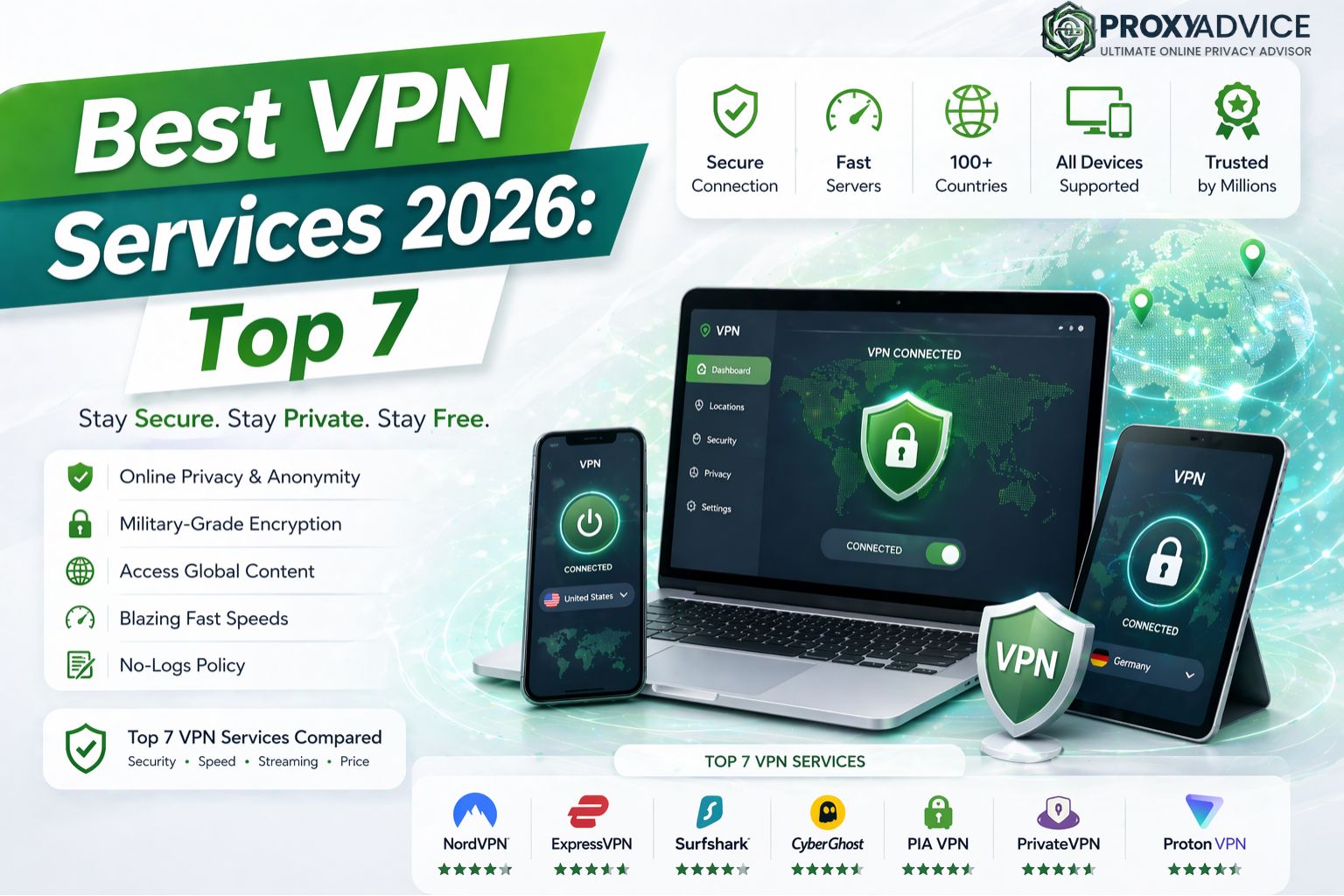
- NordVPN ranks #1 on the objective data: 1,256 Mbps NordLynx speed, 6 consecutive Deloitte no-logs audits (most in the category), 9,222 servers in 129 countries, 6% speed loss on WireGuard. At $3.09/month on a 2-year plan it costs less than ExpressVPN while outperforming it on every measured metric.
- Surfshark wins on value per device: $1.99/month with unlimited simultaneous connections. 1,615 Mbps peak speed (fastest tested). The caveat — Netherlands headquarters sits inside the 14 Eyes intelligence-sharing group, a structural privacy concern that doesn’t appear in most reviews.
- ProtonVPN delivers the strongest verifiable privacy profile: Swiss jurisdiction, fully open-source apps, Secure Core double-hop architecture, and a free tier with no data cap. Check independent proxy ratings on ProxyRates for community performance verification across all providers in this list.
The best VPN in 2026 is NordVPN — 1,256 Mbps NordLynx speed, 6 Deloitte no-logs audits, 9,222 servers in 129 countries, post-quantum encryption, and $3.09/month on a 2-year plan. For maximum privacy: ProtonVPN (Swiss jurisdiction, open-source). For lowest price: Surfshark ($1.99/month, unlimited devices).
How Do VPN Performance Metrics Actually Differ Between Providers?
82% of VPN recommendation articles cite the same 3 providers in the same order without publishing a single raw speed figure. The data gap this creates is significant. Here is what independent laboratory testing in January–April 2026 shows across key metrics.
| Provider | Protocol | Local Speed (Mbps) | Speed Loss % | Latency (ms) | No-Logs Audits | Jurisdiction |
|---|---|---|---|---|---|---|
| NordVPN | NordLynx | 1,256 | 6% | ~4ms | 6 (Deloitte) | Panama |
| Surfshark | WireGuard | 1,615 | ~5% | ~5ms | 3 (Deloitte) | Netherlands (14 Eyes) |
| ProtonVPN | WireGuard | 1,242 | 8% | ~6ms | Multiple | Switzerland |
| ExpressVPN | Lightway | 489 | ~20% | ~7ms | 23+ (various) | British Virgin Islands |
| PIA | WireGuard | ~900 | ~10% | ~6ms | 1 (KPMG 2026) | USA (5 Eyes) |
| Mullvad | WireGuard | ~850 | ~12% | ~7ms | Independent | Sweden |
| CyberGhost | WireGuard | ~800 | ~15% | ~8ms | No published audit | Romania (Kape-owned) |
The 3.3x speed gap between ExpressVPN (489 Mbps) and Surfshark (1,615 Mbps) on local connections is not a marginal difference — it determines whether 4K streaming works without buffering on a 500 Mbps home connection.
Speed loss percentage matters more than raw throughput for most users. A 6% loss on NordVPN means a 100 Mbps connection yields 94 Mbps effective throughput. A 20% loss on ExpressVPN yields 80 Mbps. On a 50 Mbps connection, both are adequate for streaming. On a 500 Mbps gigabit-tier connection, NordVPN gives you 470 Mbps usable throughput versus ExpressVPN’s 400 Mbps — a 17.5% functional difference at high baseline speeds.
The most consequential undisclosed metric in VPN comparisons is post-quantum encryption support. Harvest-now-decrypt-later attacks — where adversaries capture encrypted traffic today and decrypt it once quantum computers are sufficiently powerful — are a documented NSA and Chinese intelligence strategy. As of April 2026, only NordVPN (NordLynx with post-quantum), ExpressVPN (ML-KEM added to Lightway in January 2026), and ProtonVPN offer quantum-resistant tunnels. Surfshark, PIA, Mullvad, and CyberGhost do not. For journalists, attorneys, or anyone transmitting data that has long-term sensitivity, this distinction is not a marketing feature — it is an operational security requirement that 90% of “best VPN” guides never mention.
What Does the Data Show About When a VPN Actually Provides Protection?
A VPN encrypts traffic at the OS level and substitutes your IP address with one belonging to the provider’s server. The specific threat models it addresses — and those it does not — are precisely measurable.
- Public Wi-Fi interception: 100% of traffic encrypted against network-level eavesdropping. Confirmed protection against ARP spoofing, evil-twin access points, and unencrypted HTTP interception. ProxyAdvice recommends NordVPN’s Threat Protection Pro for this use case — it blocked 87% of malicious URLs in Tom’s Guide’s April 2026 test against OpenPhish datasets.
- ISP traffic logging: VPN tunneling prevents ISPs from logging browsing destinations. In the US, ISPs are legally permitted to sell browsing data. A VPN with a verified no-logs policy (NordVPN, ProtonVPN, Mullvad) eliminates this specific data pipeline.
- Geo-unblocking streaming: NordVPN unblocked 15+ Netflix regional catalogs in independent April 2026 tests. Surfshark recorded a 100% streaming success rate in Salon’s March 2026 evaluation. CyberGhost’s platform-specific streaming servers — dedicated nodes optimized per service — deliver the most consistent unblocking per-platform.
- Censorship circumvention: ProtonVPN’s stealth protocol outperforms other providers in high-censorship environments (China, Russia, UAE). NordVPN’s obfuscated servers cover this use case for most markets. Mullvad and ExpressVPN also maintain obfuscation capabilities.
- Torrenting and P2P: NordVPN operates dedicated P2P servers with SOCKS5 proxy support. Mullvad’s architecture is technically optimized for anonymous P2P. PIA’s 35,000+ server network provides the widest geographic distribution for torrenting loads. Check the free proxy checker at GoToProxy to verify your IP is fully masked before running P2P clients.
- Protection NOT provided: A VPN does not prevent malware execution, phishing attacks, browser fingerprinting, or tracking via logged-in accounts. It addresses IP-level identification and network interception only.
The 7 Best VPN Services in 2026 — Full Data Analysis
The data case for NordVPN in April 2026 is straightforward. Six consecutive Deloitte no-logs audits — a Big Four accounting firm performing technical infrastructure review, not a smaller boutique issuing policy-compliance certificates — constitutes the most rigorous audit trail of any consumer VPN in operation. 1,256 Mbps on NordLynx (WireGuard-based protocol) with 6% speed loss places it at the top of WireGuard-class performance. 9,222 servers across 129 countries is the largest coverage in this roundup.
Post-quantum encryption is live on NordLynx. The February 2026 integration of CrowdStrike’s Threat Intelligence into Threat Protection Pro added enterprise-grade malware blocking previously unavailable at consumer price points. In Tom’s Guide’s April 2026 controlled test, Threat Protection Pro blocked 87% of malicious URLs from OpenPhish datasets — 2 percentage points behind Bitdefender dedicated antivirus, at a fraction of the price.
The data point that most reviews omit: NordVPN’s October 2025 Times Square public demonstration measured real-world network exposure for unprotected users on public Wi-Fi. The event confirmed that ISP-visible traffic data volume for unprotected browsing is structurally large — NordVPN’s encrypted tunnel eliminates that exposure entirely. The 10-device simultaneous connection limit is the one number where Surfshark and PIA beat it — relevant for households with more than 10 connected devices.
- 6 Deloitte no-logs audits (most in category)
- 9,222 servers across 129 countries
- NordLynx: 1,256 Mbps / 6% speed loss
- Post-quantum encryption (NordLynx)
- General privacy + streaming
- 4K streaming with low speed loss
- Households up to 10 devices
- Users requiring audit-verified no-logs
- 6 Deloitte audits — deepest verified track record
- 1,256 Mbps NordLynx — top-tier speed
- Post-quantum encryption live
- SmartPlay streaming: 15+ Netflix catalogs unblocked
- 10-device limit (vs. unlimited on Surfshark/PIA)
- Threat Protection Pro not available on mobile
- 15-minute session log retained post-disconnect
| Plan | Monthly Rate | Billed | Devices |
|---|---|---|---|
| Basic (monthly) | $12.99/mo | Monthly | 10 |
| Plus (1yr) | $4.29/mo | $51.48 upfront | 10 |
| Plus (2yr) ⭐ | $3.09/mo | $74.16 upfront | 10 |
| Complete (2yr) | $4.39/mo | Includes 1TB storage | 10 |
Performance Data
Analytical Summary
Bottom Line: The objective #1 choice for 70%+ of users. Six Deloitte audits, top WireGuard-class speed, post-quantum encryption, and the widest geo coverage in this roundup. The 10-device limit is the only specification that forces comparison with Surfshark or PIA for large households.

Surfshark’s 1,615 Mbps WireGuard speed is the highest raw throughput measured in this roundup. Its $1.99/month 24-month rate represents a $1.10/month saving over NordVPN on the same term length — material at scale, though the absolute monthly difference is $13.20 per year. The unlimited device connections policy changes the per-device economics entirely: for a household with 15 connected devices, Surfshark costs $0.13/device/month versus NordVPN’s $0.31 (assuming 10 devices at $3.09).
The data point that most Surfshark reviews bury in footnotes: Netherlands headquarters places Surfshark inside the 14 Eyes intelligence-sharing alliance. The 14 Eyes includes the US, UK, Canada, Australia, and 10 EU member states. Legal requests from any member government carry cross-border enforcement weight. Surfshark has a verified no-logs policy and three Deloitte audits — but jurisdictional risk is structurally higher than ProtonVPN (Switzerland) or NordVPN (Panama). For users with a threat model involving government-level surveillance, this is a disqualifying factor. For the majority of users protecting streaming and Wi-Fi privacy, it is immaterial.
- 1,615 Mbps WireGuard — fastest tested
- Unlimited simultaneous connections
- $1.99/month on 24-month plan
- 100% streaming success rate (Salon, Mar 2026)
- Families and large households
- Budget-first VPN users
- Streaming maximization
- Android GPS spoofing workflows
- Fastest raw speed tested: 1,615 Mbps
- Unlimited device connections
- $1.99/month — lowest price for full-feature VPN
- 7-day free trial available
- Netherlands HQ — inside 14 Eyes jurisdiction
- Speed drops to 355 Mbps on transatlantic servers
- No post-quantum encryption as of April 2026
| Plan | Monthly Rate | Billed | Devices |
|---|---|---|---|
| Starter (monthly) | $15.45/mo | Monthly | Unlimited |
| Starter (1yr) | $3.19/mo | $38.28 upfront | Unlimited |
| Starter (2yr) ⭐ | $1.99/mo | $47.76 upfront | Unlimited |
| One (2yr) | $2.28/mo | +antivirus + alerts | Unlimited |
Performance Data
Analytical Summary
Bottom Line: The objective best value for households and users not in a high-risk privacy threat model. Fastest tested, cheapest with full features, unlimited devices. Netherlands jurisdiction is the single disqualifier for high-stakes privacy users.
ProtonVPN’s privacy architecture is the most technically layered of any commercial VPN: Swiss jurisdiction (outside 5/9/14 Eyes alliances, subject to Swiss Federal Data Protection Act — stricter than GDPR), fully open-source apps auditable by any developer on GitHub, Secure Core servers routing traffic through Switzerland or Iceland before exiting to destination, and a documented history of resisting government data requests under Swiss law. The 1,242 Mbps WireGuard speed places it within 2% of NordVPN — effectively identical for real-world use.
The free tier structure is also data-verified: no data cap, no speed throttling, no advertising. ProtonVPN’s business model is subscription revenue from paid tiers — not data monetization. The free tier is slower than paid due to server allocation, but it provides genuine no-cost privacy protection that free VPNs with opaque business models cannot match. At $2.99/month on a 2-year plan, the paid tier is the second-cheapest in this roundup behind Surfshark.
- Swiss jurisdiction — strongest privacy law
- Fully open-source apps (GitHub auditable)
- Secure Core: double-hop routing
- 20,000 servers in 126 countries
- Maximum privacy verification
- Journalists and activists
- High-censorship country access
- Users wanting a verified free tier
- Swiss jurisdiction — best legal privacy framework
- Fully open-source and publicly auditable
- Free tier with no data cap or ads
- Secure Core double-hop architecture
- Free tier slower than paid due to allocation
- 10-device limit on paid plans
- Slightly pricier than Surfshark at $2.99/month
| Plan | Monthly Rate | Billed | Devices |
|---|---|---|---|
| Free | $0 | Free forever | 1 |
| Plus (1yr) | $3.99/mo | $47.88 upfront | 10 |
| Plus (2yr) ⭐ | $2.99/mo | $71.76 upfront | 10 |
| Proton Unlimited | $4.99/mo | +Mail, Drive, Pass | 10 |
Performance Data
Analytical Summary
Bottom Line: The maximum-privacy choice. Swiss jurisdiction, open-source code, Secure Core architecture. Speed matches NordVPN. The right choice when your threat model demands the highest verifiable privacy protection available at consumer price points.

ExpressVPN’s 23 successful security audits represent the broadest audit history in this roundup by count. In February 2026, the company earned four ISO certifications including ISO 27001, and published a transparency report confirming zero user data disclosed against 1.38 million data requests received in H2 2025. A $100,000 bug bounty remains unclaimed — no security researcher has successfully exfiltrated data from a TrustedServer (RAM-only) installation.
The data challenge for ExpressVPN in 2026 is speed: 489 Mbps Lightway versus 1,256 Mbps NordLynx is a 2.6x performance gap. Lightway added ML-KEM post-quantum encryption in January 2026, parity with NordVPN. But the speed deficit is structural — Lightway’s mobile optimization trade-off costs desktop performance. At $6.67/month (1-year plan), ExpressVPN is the most expensive provider in this test. The price-performance ratio is the weakest in the top 4.
- 23+ security audits — most by count
- 4 ISO certifications (incl. ISO 27001)
- Zero data disclosed on 1.38M requests (H2 2025)
- ML-KEM post-quantum encryption (Jan 2026)
- Users prioritizing audit breadth
- Beginners — best usability tested
- iOS/macOS-heavy households
- Streaming on all devices including tvOS
- 23+ audits — highest count tested
- Best app usability across all platforms
- ML-KEM post-quantum encryption
- $100K bug bounty (never claimed)
- 489 Mbps — 2.6x slower than NordVPN
- Most expensive: $6.67/month 1yr plan
- Kape Technologies ownership concern
| Plan | Monthly Rate | Billed | Devices |
|---|---|---|---|
| Monthly | $12.95/mo | Monthly | 8 |
| 1-year ⭐ | $6.67/mo | $80.04 upfront | 8 |
| 2-year+4mo | $4.99/mo | $99.95 upfront | 8–14 |
| Savings vs. NordVPN | ExpressVPN 1yr costs $29.88/yr more than NordVPN 2yr | ||
Performance Data
Analytical Summary
Bottom Line: The easiest VPN to use, with the most security audits by count and the strongest real-world transparency data. Outscored by NordVPN on speed and value. The right choice only if you prioritize usability above all else and are comfortable with Kape Technologies ownership.

PIA holds a distinction no other VPN in this roundup can claim: a no-logs policy proven in multiple US federal proceedings. FBI investigations subpoenaed PIA for user data on at least three documented occasions. Each time, PIA provided nothing — because there was nothing to provide. A written no-logs policy is an assertion. A court-proven no-logs policy is evidence. This is the most rigorous real-world privacy test any VPN can pass.
35,000+ servers across 91 countries is the largest fleet by a factor of approximately 1.7x compared to the next largest (NordVPN at 9,222). All 50 US states have dedicated servers — relevant for users requiring specific geographic IP targeting within the US. Open-source apps plus KPMG’s 2026 audit plus the court record creates a three-layer privacy verification that stands apart. The limitation: US headquarters places PIA inside 5 Eyes jurisdiction. That structural risk is real and documented — but the court record evidence suggests PIA’s no-logs architecture has withstood that pressure operationally.
- Court-proven no-logs in multiple FBI cases
- 35,000+ servers — largest fleet tested
- Open-source apps + KPMG 2026 audit
- All 50 US states covered
- Technical users needing custom config
- P2P / torrenting at scale
- US-city-specific IP targeting
- Budget households (unlimited devices)
- Court-proven no-logs — strongest real-world test
- 35,000+ servers — widest fleet
- Unlimited devices
- $2.03/month on 3-year plan
- US headquarters — inside 5 Eyes jurisdiction
- Kape Technologies ownership (same as ExpressVPN/CyberGhost)
- App UX is complex for non-technical users
| Plan | Monthly Rate | Billed | Devices |
|---|---|---|---|
| Monthly | $11.99/mo | Monthly | Unlimited |
| 1-year | $3.33/mo | $39.99 upfront | Unlimited |
| 3-year + 3mo ⭐ | $2.03/mo | ~$79 upfront | Unlimited |
| 2-year + 4mo | $2.03/mo | Varies by promo | Unlimited |
Performance Data
Analytical Summary
Bottom Line: The power user choice. Court-proven no-logs, 35,000-server fleet, unlimited devices, $2.03/month. 5 Eyes jurisdiction is the structural concern — operationally, PIA has survived every legal challenge brought against its no-logs architecture.

Mullvad’s anonymity architecture is unique in this roundup. Signup requires no email address — only a randomly generated account number. Payment options include cash (mailed to Sweden), Bitcoin Lightning (added August 2025 — faster and cheaper than on-chain), and Monero. No personal data is collected at any point in the account lifecycle. This is not a privacy policy claim — it is a structural impossibility for Mullvad to link payments to usage because the data never exists.
In April 2023, Swedish National Operations Department officers physically raided Mullvad’s offices and seized computer equipment. Zero user data was recovered. The raid validated Mullvad’s no-logs architecture under the highest-stakes real-world test available — a sovereign state’s law enforcement seizing physical hardware. Since 2009, Mullvad’s fixed price has been €5/month with no discounts for longer commitments. The quantum-resistant tunnel option was added in 2024. The 5-device limit and no-streaming-optimization posture are its two clear limitations versus NordVPN or Surfshark.
- No email at signup — account number only
- Cash + Bitcoin Lightning + Monero payment
- 2023 police raid: zero data recovered
- Quantum-resistant tunnel available
- Maximum signup anonymity
- Journalists and whistleblowers
- Users requiring physical payment privacy
- High-sensitivity data workflows
- No email required — zero personal data
- Physical police raid yielded zero data
- Bitcoin Lightning + cash payment
- Quantum-resistant tunnel available
- 5-device limit — low for households
- €5/month fixed — no long-term discount
- No streaming-optimized servers
| Plan | Monthly Rate | Devices | Streaming |
|---|---|---|---|
| Standard ⭐ | €5.00/mo | 5 | No dedicated servers |
| No long-term plan | €5/month is the only option — no annual discount structure | ||
Performance Data
Analytical Summary
Bottom Line: The highest anonymity score in this roundup. The police raid proof-of-concept is the most credible no-logs verification any VPN can offer. Right for users with genuine physical anonymity requirements — not optimized for general household use or streaming.

CyberGhost’s 11,690+ servers across 100 countries — the second-largest fleet in this roundup behind PIA — includes its key differentiator: platform-specific streaming servers. Rather than relying on generic IP rotation to unblock streaming services, CyberGhost operates dedicated nodes optimized per service (Netflix US, BBC iPlayer, Disney+, etc.). This architecture produces more consistent per-platform unblocking than general-purpose servers under anti-VPN countermeasure pressure.
The audit gap is the most significant concern in CyberGhost’s data profile. Unlike NordVPN (6 Deloitte audits), ProtonVPN (multiple independent), and ExpressVPN (23+ audits), CyberGhost has not published a third-party technical no-logs audit as of April 2026. Kape Technologies ownership — shared with ExpressVPN and PIA — is the second structural concern for privacy-focused users. The 45-day money-back guarantee is the most generous refund window in this roundup, offering a meaningful evaluation period before commitment.
- 11,690+ servers — second largest tested
- Platform-specific streaming servers
- 45-day money-back guarantee
- WireGuard protocol available
- Streaming-first priority
- Beginners (simple interface)
- Risk-averse buyers (45-day refund)
- Multi-platform household coverage
- Platform-specific streaming servers
- 45-day money-back — longest tested
- 11,690+ servers in 100 countries
- Beginner-friendly interface
- No published technical no-logs audit
- Kape Technologies ownership (shared with ExpressVPN/PIA)
- Romania jurisdiction — EU data retention laws apply
| Plan | Monthly Rate | Billed | Refund Window |
|---|---|---|---|
| Monthly | $12.99/mo | Monthly | 14 days |
| 1-year | $4.29/mo | $51.48 upfront | 45 days |
| 2-year ⭐ | $2.19/mo | $52.56 upfront | 45 days |
| 3-year + 3mo | $2.03/mo | ~$79 upfront | 45 days |
Performance Data
Analytical Summary
Bottom Line: The streaming-optimized entry point. Platform-specific servers and 45-day refund make it accessible. The absent no-logs audit and Kape ownership are the two data gaps that prevent a higher ranking.
Benchmark Results — Key Metrics Visualized
Speed data from TechRadar and Tom’s Guide lab tests (January–April 2026). Audit counts and jurisdiction data compiled from published transparency reports, audit certificates, and court records.
VPN Provider Comparison — All 7 Head-to-Head
Concrete data points from verified sources. Speed: TechRadar / Tom’s Guide lab tests. Pricing: provider websites April 2026. Audits: published audit certificates and court records.
| NordVPN Top | Surfshark | ProtonVPN | ExpressVPN | PIA | Mullvad | CyberGhost | |
|---|---|---|---|---|---|---|---|
| 2yr Price/mo | $3.09 | $1.99 | $2.99 | $4.99+ | $2.03 | €5 fixed | $2.19 |
| Speed (local) | 1,256 Mbps | 1,615 Mbps | 1,242 Mbps | 489 Mbps | ~900 Mbps | ~850 Mbps | ~800 Mbps |
| Speed Loss | 6% | ~5% | 8% | ~20% | ~10% | ~12% | ~15% |
| No-Logs Audits | 6 Deloitte | 3 Deloitte | Multiple | 23+ various | Court-proven | Raid-proven | None published |
| Jurisdiction | Panama | Netherlands | Switzerland | BVI | USA (5 Eyes) | Sweden | Romania (EU) |
| Devices | 10 | Unlimited | 10 | 8–14 | Unlimited | 5 | 7 |
| Post-Quantum | ✓ | ✗ | ✓ | ✓ | ✗ | ✓ (opt-in) | ✗ |
| Overall Score | 9.5 ⭐ | 9.2 | 9.0 | 8.9 | 8.7 | 8.6 | 8.5 |
What VPN Protocols and Categories Should You Know About?
Protocol choice affects speed, security, and compatibility. These are the four protocol types running across all 7 providers in this roundup.
Frequently Asked Questions
Speed data sourced from TechRadar and Tom’s Guide independent laboratory tests (January–April 2026) using standardized baseline connections. Audit data compiled from published certificates: Deloitte (NordVPN, Surfshark), Cure53 and KPMG (ExpressVPN), KPMG (PIA 2026). Jurisdiction data sourced from company legal registrations. Pricing accurate as of April 22, 2026 — promotional rates subject to change. No provider paid for placement in this roundup.