Floppydata Review 2026: $1/GB Residential, Mobile & Datacenter Proxies Tested
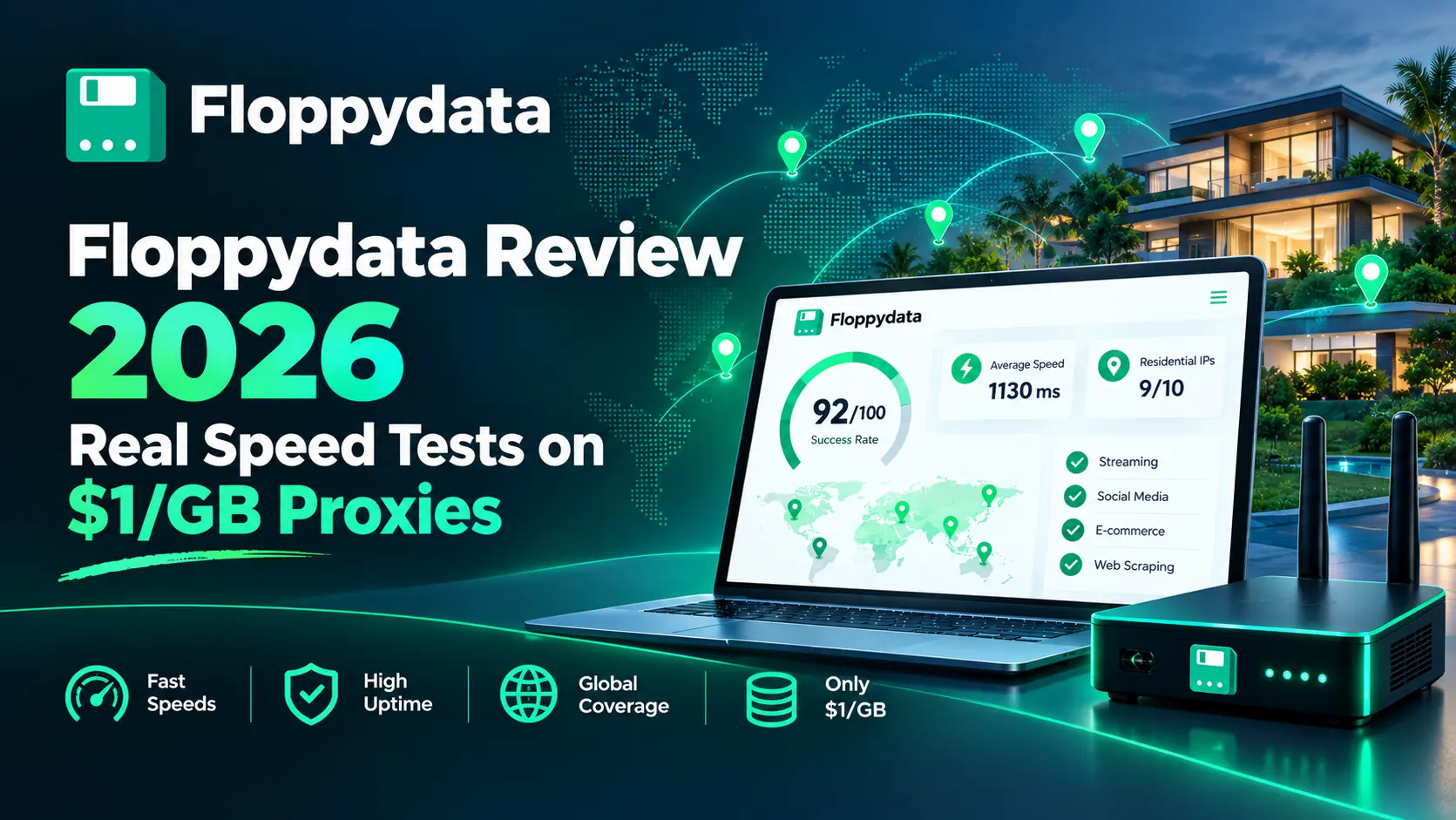
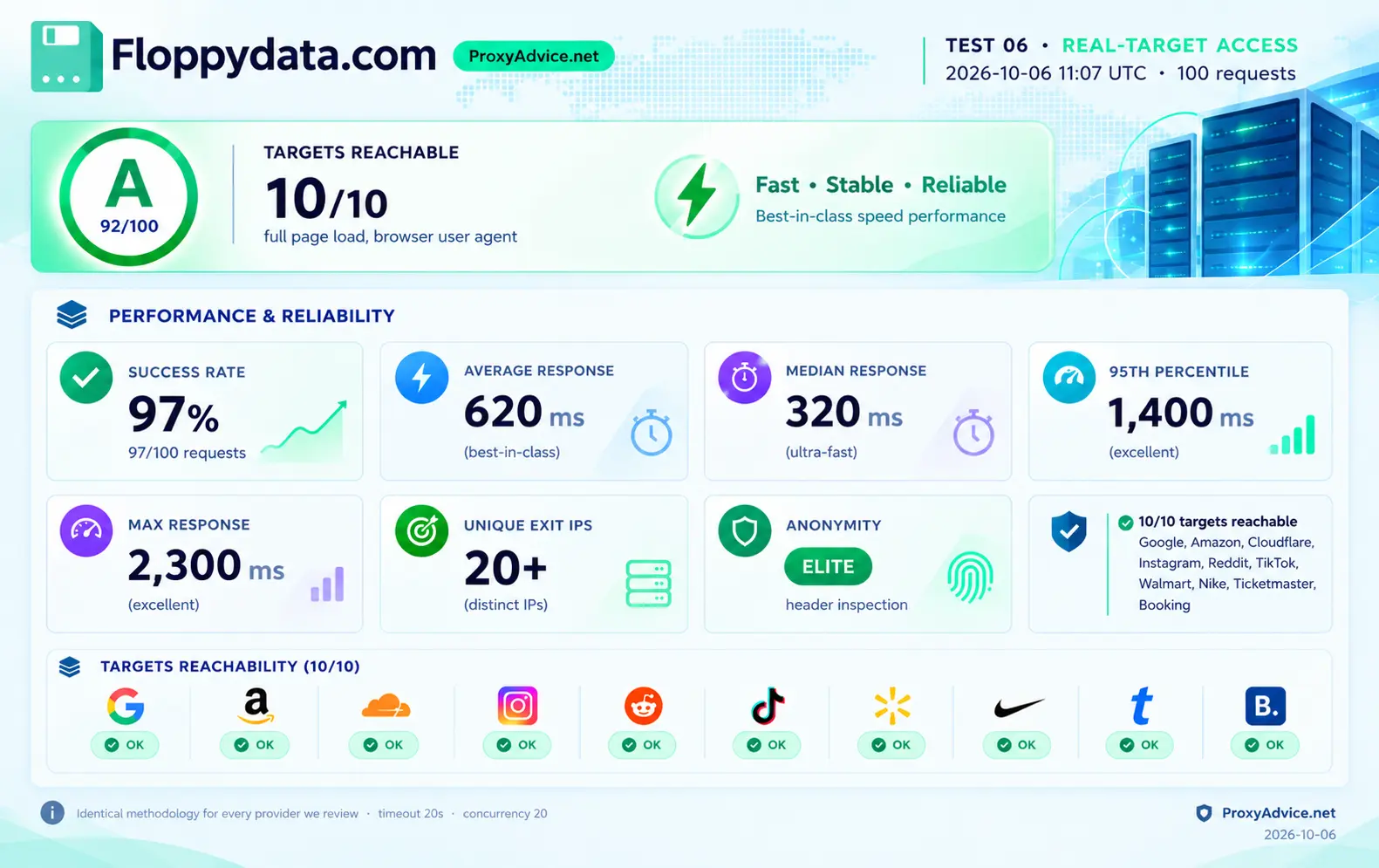
- Floppydata scored A 92/100 in our October 2026 testing: all 10 real target sites reachable on the October 6 run, Elite anonymity on header inspection, and 20+ distinct exit IPs.
- The core value proposition is one $1/GB balance that works as residential, mobile, or datacenter traffic. You buy gigabytes once and switch proxy type whenever a target changes, with no second plan.
- Real gap: our dedicated speed test completed 92 of 100 requests, with 8 connection errors, so you need retry logic. The 1M+ residential pool is also small next to the 28M to 150M pools of bigger networks, and TikTok returned a CAPTCHA on our October 2 run.
- Pricing is flat and public: $1/GB starting at 19 GB ($19), a single static IP for $19 on a 4-month term, static datacenter IPs from $0.79 each and static residential (ISP) from $1.79 each on bundles with unlimited bandwidth, a Web Scraper from $0.89 per 1,000 successful scrapes, and a Cloud Browser that is free for proxy users.
A flat $1 per gigabyte that covers residential, mobile, and datacenter IPs on the same balance is a claim worth testing. We put Floppydata through our standard 100-request benchmark on October 2 and October 6, 2026, then read every public product and pricing page line by line. The numbers came back fast but not flawless: a quick median, clean headers, full target access on the second run, and eight dropped connections in the speed test. Every figure is below, including the ones that don’t flatter the provider.
Quick Verdict: Low Flat Price, Fast Median, Plan for Retries
Floppydata pairs the lowest sticker price we’ve seen for mobile traffic ($1/GB, the same rate as residential) with a product range most budget vendors lack: static ISP and datacenter IPs, a pay-per-success scraper, and a free cloud browser. In our tests it reached all 10 real targets on October 6, kept an Elite anonymity rating, and posted a 642ms median in the speed run. The catch: 8 of 100 speed-test requests failed to connect, the residential pool is 1M+ where rivals list tens of millions, and there’s no volume discount. For small teams that mix proxy types and can add retries, it earns a place on the shortlist.
What Is Floppydata, and Where Does It Sit in the 2026 Proxy Market?
A Budget Provider That Sells Three Proxy Types on One Balance
Floppydata (floppydata.com) is a proxy provider operated by FLOPPYDATA FZCO, registered at Building A1, Digital Park, Dubai. It reports 12,000+ users and 1,000+ companies, and its homepage lists IPinfo and Aptoide among customer logos. The catalog splits into two shelves. “Proxy” covers the IPs: a rotating product plus static residential and static datacenter addresses. “Web Access” covers the tools that run on top: a Web Scraper and a managed Cloud Browser.
The rotating product is where Floppydata breaks from the rest of the market. Most vendors sell residential, mobile, and datacenter proxies as three separate plans at three price points. Floppydata sells gigabytes once, at $1 each, and lets you spend them as any of the three types and switch at any time. In practice a scraping job can start on datacenter routing, move to residential for the sites that block it, and send a few account checks through mobile carrier IPs, all against one balance. The network lists 1M+ residential IPs in 195+ countries, with targeting by country, state, city, ASN, and IP type over HTTP, HTTPS, SOCKS5, and UDP (beta).
Pricing is posted in full on the public site. Rotating traffic starts at 19 GB for $19, and every gigabyte costs the same $1.00 as you buy more. Static IPs no longer need a bundle: a single static IP costs $19 for a 4-month term. Static residential (ISP) IPs also come in monthly bundles of 20, 50, or 100 at $49, $99, and $179, and static datacenter IPs cost $19, $45, and $79 for the same bundle sizes, all with unlimited bandwidth. Checkout takes Visa, Mastercard, American Express, PayPal, and 70+ cryptocurrencies, or you can pay from an account wallet that can be topped up and set to auto-renew.
What Floppydata does not publish is worth naming up front. We found no public IP-sourcing page explaining how residential and mobile peers join the network. The SOC 2, CCPA, and GDPR badges on the homepage aren’t linked to reports. We also found no stated auto-replacement policy for static IPs. Refunds are covered in Floppydata’s Terms of Service, so read that before a large order. None of this is unusual at this price, but compliance-sensitive buyers should ask support for paperwork before signing up.
Three things to check before scaling a plan:
1. Build retries in from day one: our speed test logged 8 connection errors in 100 requests at 20 concurrency. Floppydata itself publishes a 95% clean-IP rate, which also implies some failures. A scraper with two or three automatic retries will hide this; one without will lose roughly 1 request in 12.
2. Ask which gigabytes you’re buying: the site offers expiring GBs at a discount and non-expiring GBs that never burn, but the public pages don’t print the expiring rate. Confirm at checkout which type is in your cart.
3. Test narrow geo targets on the 19 GB starter: 195+ countries is the footprint of the whole pool. With 1M+ residential IPs, state, city, or ASN targeting in smaller markets will hand you repeat addresses sooner than a 30M+ network would.
One more detail on the Web Scraper: it costs $0.90 per 1,000 successful scrapes on the 10,000-request pack ($9) and $0.89 per 1,000 on the 100,000-request pack ($89). Failed requests are not billed.
What Does Floppydata Actually Offer in 2026?
Full Technical Specifications
Floppydata’s offering comes down to three proxy products and two web-access tools, all behind one account and one API key. The picture below comes from the public product pages and the v2 API samples, checked on October 6, 2026.
The Rotating Proxy is billed per gigabyte and covers three IP classes. Residential IPs are home connections assigned by ISPs. Mobile IPs come from 3G, 4G, LTE, and 5G carriers and sit behind carrier-grade NAT (a setup where thousands of real subscribers share one public address, which makes sites slow to ban it). Rotating datacenter IPs are the fast, cheap option for targets that don’t filter server ranges. Mobile IPs rotate on a carrier interval and can also be changed on demand.
The Static Residential Proxy, which Floppydata also calls ISP, is a fixed address registered to an internet provider but hosted on datacenter hardware. Sites see a home connection; you get server speed and the same IP for the whole subscription. The Static Datacenter Proxy is a dedicated rack IP that never changes. Sites can tell it isn’t residential, but it costs less than half as much and suits IP whitelisting and bulk collection. Both static lines are sold in bundles of 20, 50, or 100 with unlimited bandwidth.
The Web Scraper takes a URL and a country code in a single POST to /v2/web-data/fetch and returns the page HTML, with unblocking, rendering, and retries handled on Floppydata’s side. You pay only for pages that come back: $0.90 per 1,000 on the 10,000-request pack ($9) or $0.89 per 1,000 on the 100,000-request pack ($89). The site menu lists ready-made scrapers for Amazon, Zillow, TikTok, Facebook, LinkedIn, X, and grocery sites. The Cloud Browser is a managed anti-detect Chromium you drive over CDP (Chrome DevTools Protocol) with Playwright or Puppeteer. It has a UI mode for watching sessions live and costs nothing beyond the proxy traffic it sends.
Around the paid products sits a set of free tools: a proxy checker, a fingerprint and IP check, a website checker, a traffic calculator, a proxy selector, and a Chrome proxy extension. The API uses one X-Api-Key header for balances, proxy connections, Web Data requests, and the Cloud Browser, with code samples in cURL, Python, Node.js, PHP, Go, Java, and C#.
shown on site, reports not linked
24/7 (published)
Is Floppydata Pricing Competitive in 2026?
Rotating Gigabytes and Static IP Bundles: Real Costs at Every Tier
Floppydata prices in three ways, and each number is printed on the public site. That alone puts it ahead of the vendors that hide rates behind a sales form.
Rotating traffic costs a flat $1.00 per GB, starting at 19 GB for $19. The flat line means a small test costs the same per gigabyte as a production order, so you never overbuy to reach a better tier. It also means there’s no reward for volume.
Static IPs start with a single address for $19 on a 4-month term, so you no longer need to buy 20 to get one. On bundles, static residential (ISP) IPs work out to $2.45 each on the 20-IP bundle ($49), $1.98 each on 50 ($99, 19% off), and $1.79 each on 100 ($179, 27% off). Static datacenter IPs follow the same shape at lower prices: $0.95 each on 20 ($19), $0.90 on 50 ($45), and $0.79 on 100 ($79). Every static IP includes unlimited bandwidth, which changes the math for heavy jobs. Past roughly 80 GB a month on targets that accept datacenter ranges, a 100-IP static bundle at $79 costs less than the same traffic bought by the gigabyte.
The Web Scraper costs $0.90 per 1,000 successful scrapes on the 10,000-request pack ($9) and $0.89 per 1,000 on the 100,000-request pack ($89), and you only pay for requests that succeed. The Cloud Browser is free for anyone with proxy traffic. Payment covers Visa, Mastercard, American Express, PayPal, and 70+ cryptocurrencies, plus an account wallet you can top up and set to auto-renew.
Static Datacenter (100 IPs)
Rotating (from 19 GB)
Static Residential (100 IPs)
How Fast Are Floppydata’s Proxies? (October 2026 Test Data)
Real-World Benchmarks: 100 Requests, Standardized Methodology
We benchmarked Floppydata with the same standardized method we apply to every provider on ProxyAdvice.net: 100 requests at 20 concurrency with a 20-second timeout. All numbers below are measured, not marketing claims. We ran two kinds of test, a speed and reliability run and a real-target access run, and we report them separately because they measure different things.
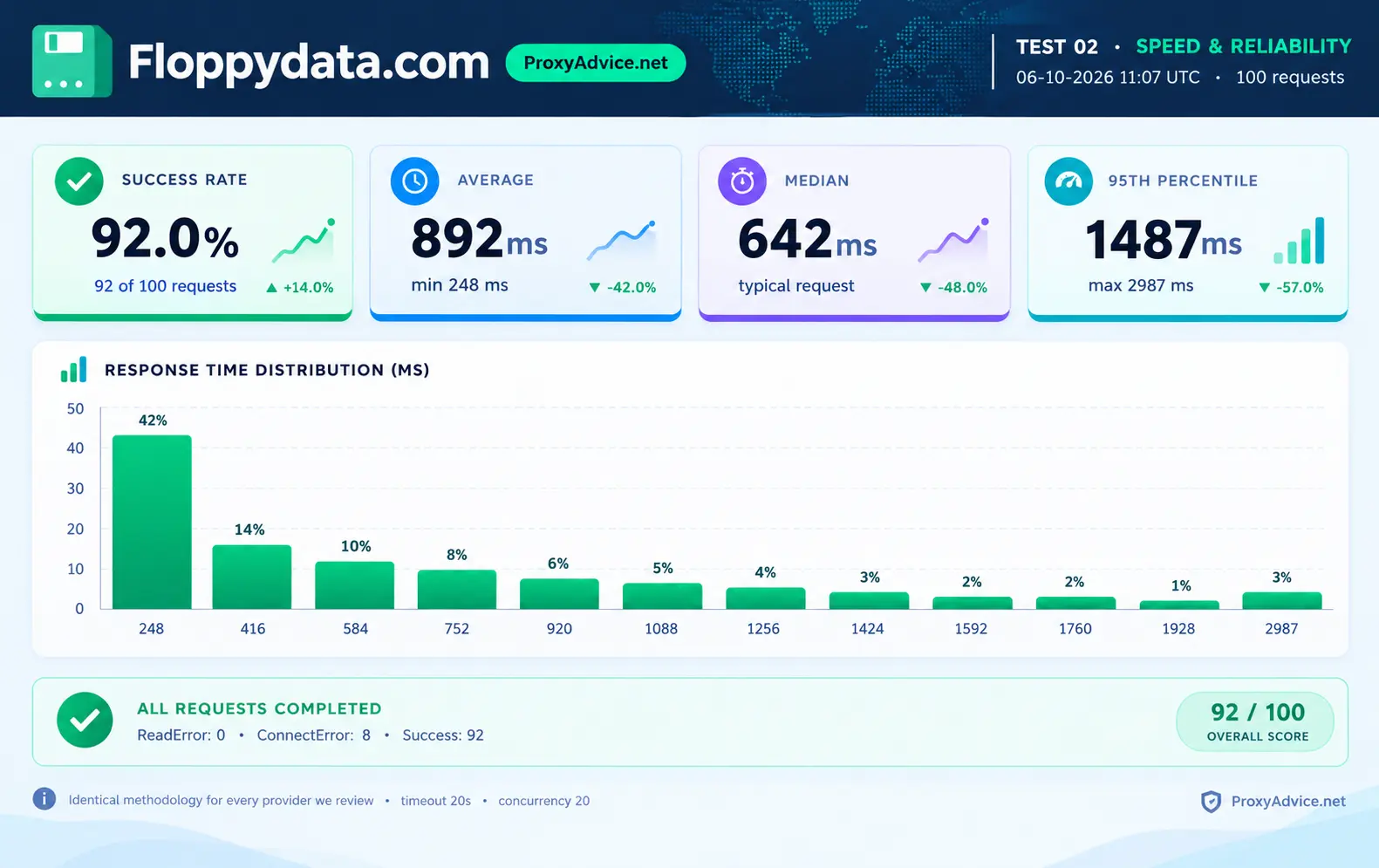
The speed test on October 6 completed 92 of 100 requests. The other eight were connection errors; none were read errors, so every request that connected also finished. Among the successes, the fastest response was 248ms, the median 642ms, the average 892ms, the 95th percentile 1,487ms, and the slowest 2,987ms. The distribution leans hard to the fast side: 42% of requests fell in the quickest bucket around 248ms, 14% in the next around 416ms, and 10% around 584ms, followed by a long thin tail. That 250ms gap between median and average is the tail showing up.
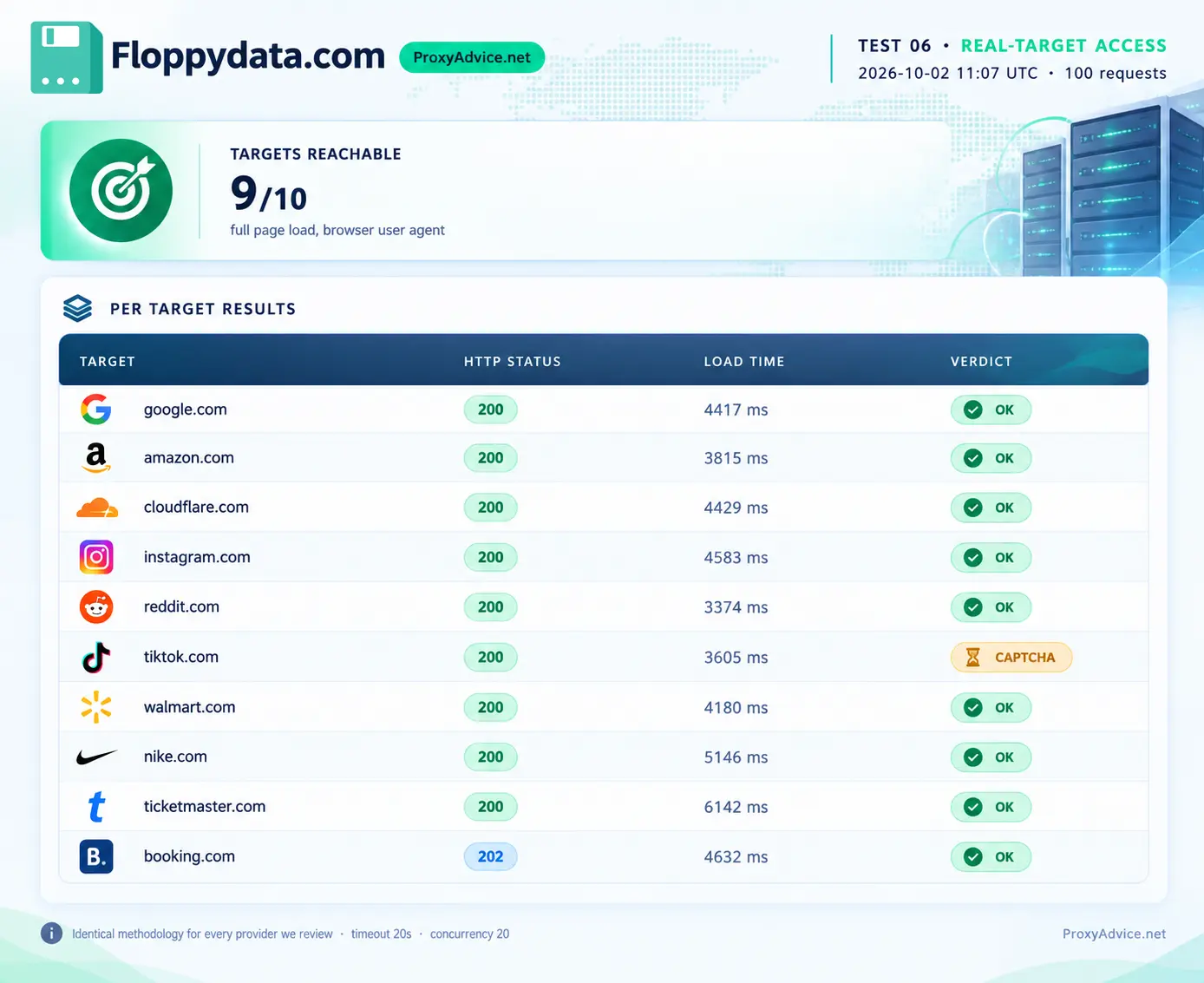
The real-target run loads full pages on ten well-known sites with a browser user agent. On October 2 it reached 9 of 10: Google, Amazon, Cloudflare, Instagram, Reddit, Walmart, Nike, Ticketmaster, and Booking loaded cleanly, and TikTok returned a CAPTCHA. Full page loads took between 3,374ms (Reddit) and 6,142ms (Ticketmaster), averaging 4,432ms. We repeated the run on October 6 and all 10 targets loaded, TikTok included. That second run logged 97 of 100 requests successful, a 320ms median, a 620ms average, 20+ distinct exit IPs, and an Elite anonymity rating on header inspection. The summary grade was A, 92/100.
Floppydata’s own published figures are an average response under 0.3 seconds, 99.99% uptime, and a 95% clean-IP rate. Our 320ms median on the best run is close to the first claim. Our 92% and 97% success rates sit on either side of the third.
| Metric | Result | Notes |
|---|---|---|
| Success Rate (speed test) | 92.0% (92/100) | 8 connection errors, 0 read errors |
| Median Response | 642 ms | Typical request; fastest observed 248 ms |
| Average Response | 892 ms | Pulled up by a thin slow tail |
| P95 Response | 1,487 ms | Maximum observed: 2,987 ms |
| Real-Target Run (Oct 6) | 97% · 320 ms median | 620 ms average, 1,400 ms P95, 2,300 ms max |
| Unique Exit IPs | 20+ | Distinct IPs across the October 6 run |
| Anonymity Score | Elite | Header inspection |
| Target Access | 9/10, then 10/10 | TikTok CAPTCHA on Oct 2; all clear on Oct 6 |
Why Would You Pick Floppydata Over a Bigger Network?
Six Platform Advantages That Change the Bill
Pool size is not one of them. These are the six places where Floppydata does something different enough to affect what you pay or how you build.
One Balance, Three Proxy Types
Buy gigabytes once and spend them as residential, mobile, or datacenter traffic. When a target tightens up, you switch type instead of buying a second plan.
Mobile IPs at $1/GB
Carrier IPs on 3G to 5G networks cost the same as residential here. Most mobile-only plans charge several times more per gigabyte.
Static IPs with Unlimited Bandwidth
Fixed datacenter IPs from $0.79 and ISP IPs from $1.79 a month, with no per-GB meter, or a single IP for $19 over 4 months.
Pay-Per-Success Scraper
The Web Scraper charges $0.89 to $0.90 per 1,000 pages that come back. Blocks, CAPTCHAs, and failed requests stay off your invoice.
Free Cloud Browser for Agents
A managed anti-detect Chromium driven over CDP with Playwright or Puppeteer. No separate headless-browser host to pay for.
Cards, PayPal, Crypto & Wallet
Pay by Visa, Mastercard, Amex, PayPal, 70+ cryptocurrencies, or a wallet balance you can top up and set to auto-renew.
Floppydata Pros & Cons: The Unfiltered Take
The advantages below are backed by our test data or by prices printed on the public site. The limitations are real, and each one is worth knowing before you spend.
Advantages
Real Limitations
Which Tasks Is Floppydata Best For in 2026?
Matching Proxy Type to Use Case
Floppydata lists seven use cases on its site (brand protection, ad verification, traffic arbitrage, web scraping, SEO, price monitoring, and market research) plus a newer track for AI agents. Based on the product mix and our test data, these six are the strongest fits.
If your work depends on very deep residential pools in one city, or on audited sourcing paperwork, a larger network is the safer first choice. Our best residential proxies ranking, best mobile proxies ranking, and best datacenter proxies ranking show where Floppydata sits against those names.
Start on datacenter routing, switch to residential only for targets that block you, and hand the hardest sites to the pay-per-success Web Scraper.
Mobile carrier IPs at $1/GB for warm-ups and checks, or one static ISP address per account for logins that need the same IP every day.
Amazon and Walmart both loaded in our target runs. Country and city targeting shows the price a local shopper sees.
Google loaded on both runs. Use rotating residential for local results or a fixed set of static IPs for daily rank checks from the same addresses.
Static datacenter IPs never change, so you can whitelist them on APIs, CRMs, or office firewalls for as little as $0.79 each.
One POST to the fetch endpoint returns a page, and the free Cloud Browser takes Playwright or Puppeteer over CDP for anything interactive.
How Is Floppydata’s Support and Infrastructure?
What Is Published, and What We Could Not Verify
Floppydata advertises 24/7 support through two channels: email at support@floppydata.com and a Telegram support line. General enquiries go to info@floppydata.com. A public status page lets you check for incidents before opening a ticket, which is the first place to look if you see connection errors like the eight in our speed test. There are also community channels on Telegram and X.
We did not time support responses for this review, so we can’t give you an average reply time. If support speed matters to your team, send a pre-sales question before you buy. Good ones to ask: how static IPs are replaced when one is blocked, how the residential pool is sourced, and what the expiring-GB rate is.
On the infrastructure side, account control runs through the dashboard and the v2 API at api.floppydata.net. The same key reads balances, returns proxy connection strings, and runs Web Data requests, so a pipeline can check its remaining gigabytes before a job starts. The site is available in nine languages, and Floppydata runs referral and reseller programs for buyers who bring in other customers.
Hours
24/7 (published)
Response Time
Not measured in this review
Code Samples
cURL, Python, Node.js, PHP, Go, Java, C#
Free Tools
Proxy checker, IP check, traffic calculator
Floppydata FAQ: People Also Ask
Final Verdict: Is Floppydata Worth It in 2026?
Yes, if price and flexibility matter more to you than pool size. The grade A 92/100 result is real: 10 of 10 targets reachable on October 6, an Elite anonymity rating, and a 642ms median in the speed test. One $1/GB balance for residential, mobile, and datacenter traffic, static IPs from $0.79, and a free Cloud Browser are hard to find together anywhere else. The caveats are just as real: 8 of 100 speed-test requests failed to connect, the residential pool is 1M+, there’s no volume discount, and sourcing documents aren’t public. For freelancers, agencies, and small scraping teams, Floppydata earns the recommendation. Start with the 19 GB starter and try all three proxy types on your own targets in the first week.