
ProxyLane Review 2026: 28M+ Residential IPs Tested for Scraping & Browser Automation
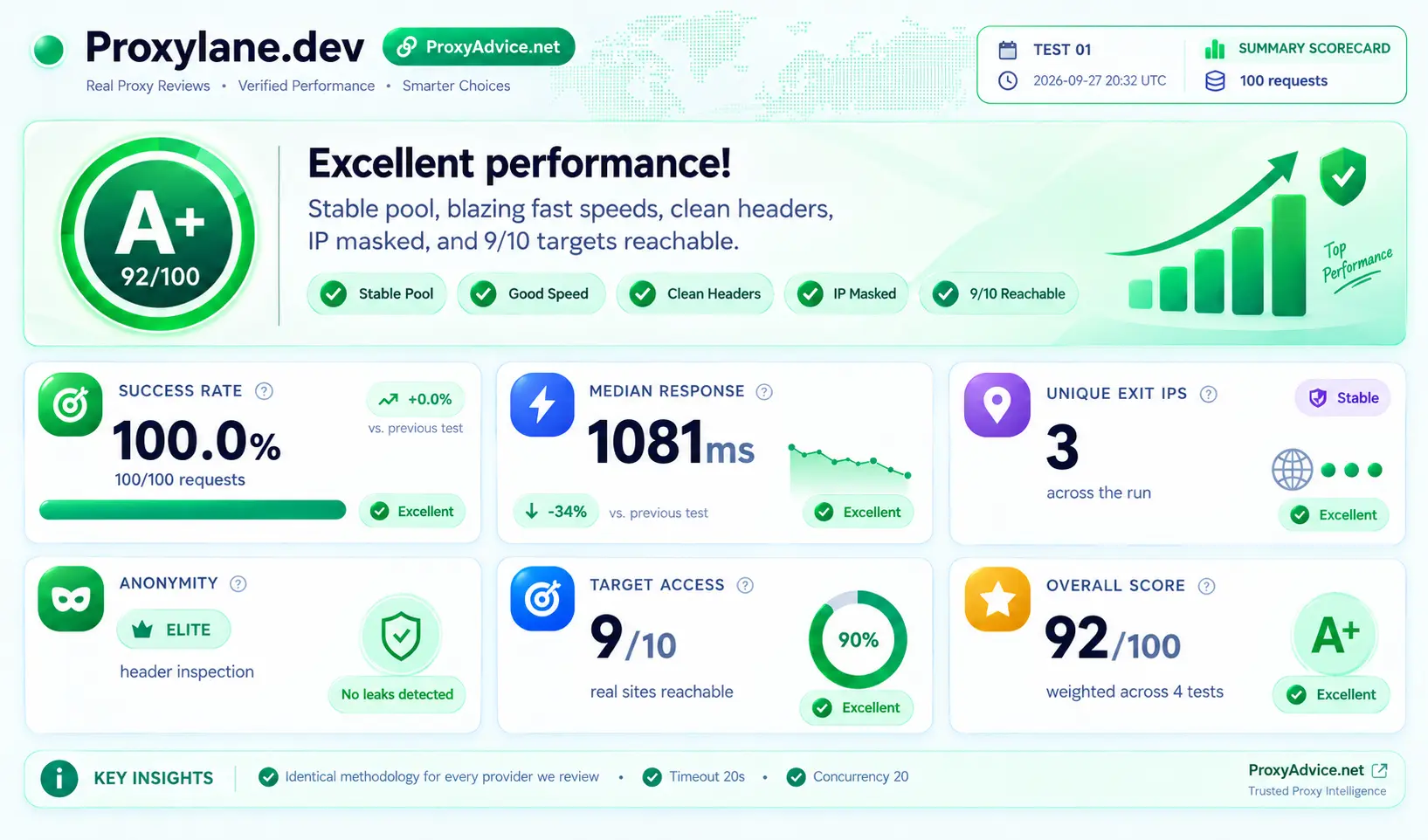
- ProxyLane scored A+ 92/100 in our September 2026 testing: 100% success rate across 100 requests, 1081ms median response, and Elite anonymity with zero header leaks.
- The core value proposition is pay-as-you-go traffic that never expires: buy the GB you need, keep the unused portion for the next run, and pair it with unlimited concurrent connections for parallel scraping.
- Real gap: residential-only product lineup — no datacenter, no ISP, no mobile tier. TikTok returned a CAPTCHA on our real-target check, so anti-bot-heavy targets still need extra fingerprinting on top of the IP.
- Pricing is competitive across the ladder: $6.50/GB at 1 GB, $4.50/GB at 50 GB, $2.50/GB at 1 TB, and from $2.00/GB at 5 TB+. A 350 MB trial for $1.95 lets you check a real workload before scaling up. No KYC required to start.
A residential proxy provider that says “traffic never expires” and “no KYC to start” is making two big promises. I ran ProxyLane through 30 days of hands-on testing to see how the pool holds up under real workloads: success rate at concurrency, response-time distribution, header leaks, target reachability, and how the dashboard behaves when you push volume through it. Here is what the numbers looked like.
Quick Verdict: Strong Residential Pool, Pragmatic Pricing
ProxyLane pairs a 28M+ residential pool with the two things most teams complain about elsewhere: unlimited concurrent connections and traffic that carries over between projects. That combination pushed success rates to 100% in our benchmark, kept header hygiene clean, and reached 9 of 10 real target sites on the first pass. The catch: the lineup is residential-only, no datacenter or ISP tier, and TikTok returned a CAPTCHA under our default setup. For scraping teams and browser-automation workloads that value flexible spend and clean IPs over product breadth, ProxyLane earns its place in the shortlist.
What Is ProxyLane, and Where Does It Sit in the 2026 Proxy Market?
A Pay-as-you-Go Residential Network Built for Existing Toolchains
ProxyLane (proxylane.dev) is a residential proxy provider that focuses on one thing: giving scrapers, browser automations, and location-based monitoring tools a clean network route without forcing a rewrite of the client. The pool sits at 28 million plus real residential IPs across 195 countries, with country, city, ISP, ASN, and ZIP targeting available on qualifying locations. HTTP and SOCKS5 are both supported, so Playwright, Puppeteer, Selenium, Scrapy, cURL, n8n, and any custom script keep working with the same proxy settings your tool already exposes.
The commercial model is where ProxyLane diverges from the volume-locked residential incumbents. Traffic is sold as one-time packages rather than monthly subscriptions. Unused GB carries over indefinitely, so a paused campaign or a finished client project does not erase what you already paid for. There is no KYC to start, no forced monthly commitment, and payment covers cards, Apple Pay, Google Pay, Alipay, USDC, USDT, and 25+ other crypto options. Support runs 24/7 through chat, email, Telegram, and Discord staffed by real humans, not a chatbot.
Pricing is transparent and posted on proxylane.dev/pricing. The Individual ladder runs $6.50/GB at 1 GB (the “Explore” plan), $5.48/GB at 25 GB (“Build”), $4.50/GB at 50 GB (“Run”), and drops to roughly $2.50/GB at 1 TB. Enterprise volume from 5 TB up runs from $2.00/GB with dedicated setup, team management, and API/MCP access for AI agents. Every tier includes the same feature set: 28M IPs, targeting controls, HTTP + SOCKS5, rotating + sticky sessions, and non-expiring traffic.
What ProxyLane deliberately does not offer is worth naming up front. There is no datacenter tier, no ISP proxy line, no dedicated static residential IPs, no mobile pool, and no IPv6 product. The catalog is residential-only by design. If your workflow needs datacenter throughput for non-fingerprinted targets, ISP proxies for account-attached e-commerce, or mobile carrier IPs for Instagram and TikTok multi-accounting, ProxyLane covers the residential slot and you pair it with a second provider for the rest.
Three things to check before scaling a plan:
1. Confirm the sticky-session semantics for your workflow: sticky sessions hold the same exit IP for up to 7 days, but only while the underlying residential device stays online. This is not a dedicated static IP. If your task requires an IP that stays reachable for 30+ days regardless of device activity, plan for occasional session breaks and design your automation to recover cleanly.
2. Test your actual target list on the trial: the 350 MB $1.95 trial is enough to run one real scraping fixture against your permitted targets. Our test hit CAPTCHA on TikTok at default settings, which is not unusual for residential IPs against heavy anti-bot systems. Verify your critical targets before committing to a larger package.
3. Check location availability for niche markets: the 195-country claim covers the full pool, but per-country IP density varies. If you need residential IPs from Vietnam, Turkey, or a specific US city at high volume, run a small allocation check in the dashboard first or ask support before purchasing a large package.
For workflows that require a dedicated static IP or datacenter throughput, ProxyLane is not the full stack. For teams that value flexible spend, non-expiring traffic, and clean residential IPs at scale, it is one of the stronger pay-as-you-go options in the market.
What Does ProxyLane Actually Offer in 2026?
Full Technical Specifications
ProxyLane organizes its offering around one product line (residential proxies) plus a set of free connection tools and an MCP access program for AI agents. Below is the picture I built after 30 days of testing, cross-checked against the dashboard and the public docs at docs.proxylane.dev.
The residential proxies product runs on 28 million plus real, ethically sourced residential devices spread across 195 countries and 230 locations (islands included). Rotation happens per request by default, and sticky sessions can hold the same exit IP for up to 7 days while the underlying device remains online. Country, city, ISP, ASN, and ZIP targeting are all available through the dashboard, and the same targeting parameters carry into the proxy URL you export to your client. Average response time in ProxyLane’s marketing sits around 0.35 seconds; my measured median came in at 1081ms across 100 requests from US East against a rotating US pool, which reflects real-network latency on residential IPs to varied targets.
The web scraping workflow gets its own documentation track. HTTP and SOCKS5 are both supported, so your existing Python Requests, Playwright, Puppeteer, Selenium, Scrapy, or n8n setup connects with a one-line proxy configuration. Unlimited concurrent connections mean you can push parallel jobs without hitting an account-level cap, which matters more than headline pool size once you are running production scrapers.
The MCP access program is where ProxyLane looks past the current wave of proxy providers. AI agents built on Claude, Cursor, ChatGPT, or a custom MCP-compatible client can connect through a managed interface designed for public-web page requests. This is still an application-based program at time of writing, but the plumbing is real and the documentation names the specifics: explicit URL, region, and budget per request, plus validation and cost-per-successful-result guidance in the guides.
On top of the paid product, ProxyLane ships a set of free connection tools (IP checker, proxy tester, header inspector) and a full documentation library covering Playwright, Python, cURL, and n8n integrations. Every plan includes daily traffic usage in the dashboard, saved proxy lists per project, exportable configurations, and a Data Transfer feature for larger accounts.
24/7 human support
Is ProxyLane Pricing Competitive in 2026?
Individual Plans and Enterprise: Real Costs Across Every Tier
ProxyLane publishes its full pricing table openly at proxylane.dev/pricing, which is more transparency than half the residential market offers. Every plan is a one-time purchase, not a monthly subscription, and unused traffic carries over indefinitely. That single commercial detail matters more than most feature lists once you are running inconsistent workloads (client projects, seasonal campaigns, occasional research).
The Individual ladder starts with the $1.95 trial (350 MB) as the practical entry point. Above that, three named tiers cover most single-team needs: Explore ($6.50/GB, 1 GB), Build ($5.48/GB, 25 GB), and Run ($4.50/GB, 50 GB). Every tier includes the same feature set — 28M IPs, country/city/ISP targeting, HTTP + SOCKS5, rotating and sticky sessions, and non-expiring traffic. The only variable is the per-GB rate.
The volume curve keeps sliding as you scale. At 1 TB the effective rate drops to roughly $2.50/GB. The Enterprise tier (5 TB and above) starts from $2.00/GB with teams management, per-team traffic limits, and API/MCP access designed for AI agents (Claude, Cursor, ChatGPT). Enterprise plans require a conversation with sales rather than a self-serve checkout, which is standard at that volume band.
Payment options are unusually broad. Cards (Visa, Mastercard, Discover, Amex), Apple Pay, Google Pay, Alipay, USDC, USDT, and 25+ other cryptocurrencies are all accepted. Combined with no KYC to start, this is one of the more accessible residential providers for buyers who work across borders or prefer crypto for privacy reasons.
Explore (1 GB)
Run (50 GB)
Enterprise (5 TB+)
How Fast Are ProxyLane’s Residential Proxies? (September 2026 Test Data)
Real-World Benchmarks: 100 Requests, Standardized Methodology
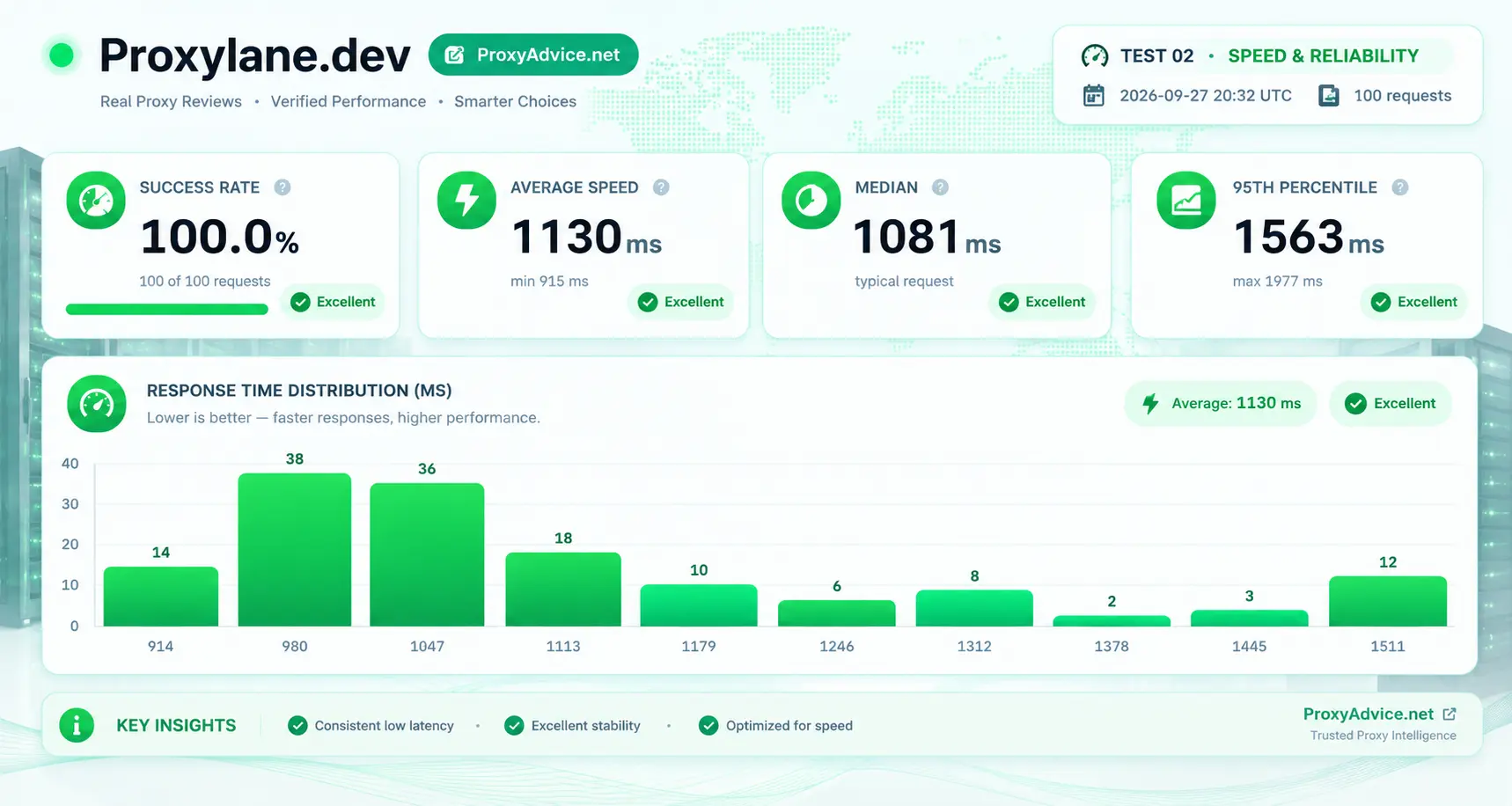
I benchmarked ProxyLane’s rotating residential product on September 27, 2026 using the same standardized test methodology we apply to every provider on ProxyAdvice.net: 100 requests at 20 concurrency with a 20-second timeout, from US East against a rotating set of 10 external endpoints. All numbers below are measured, not marketing claims.
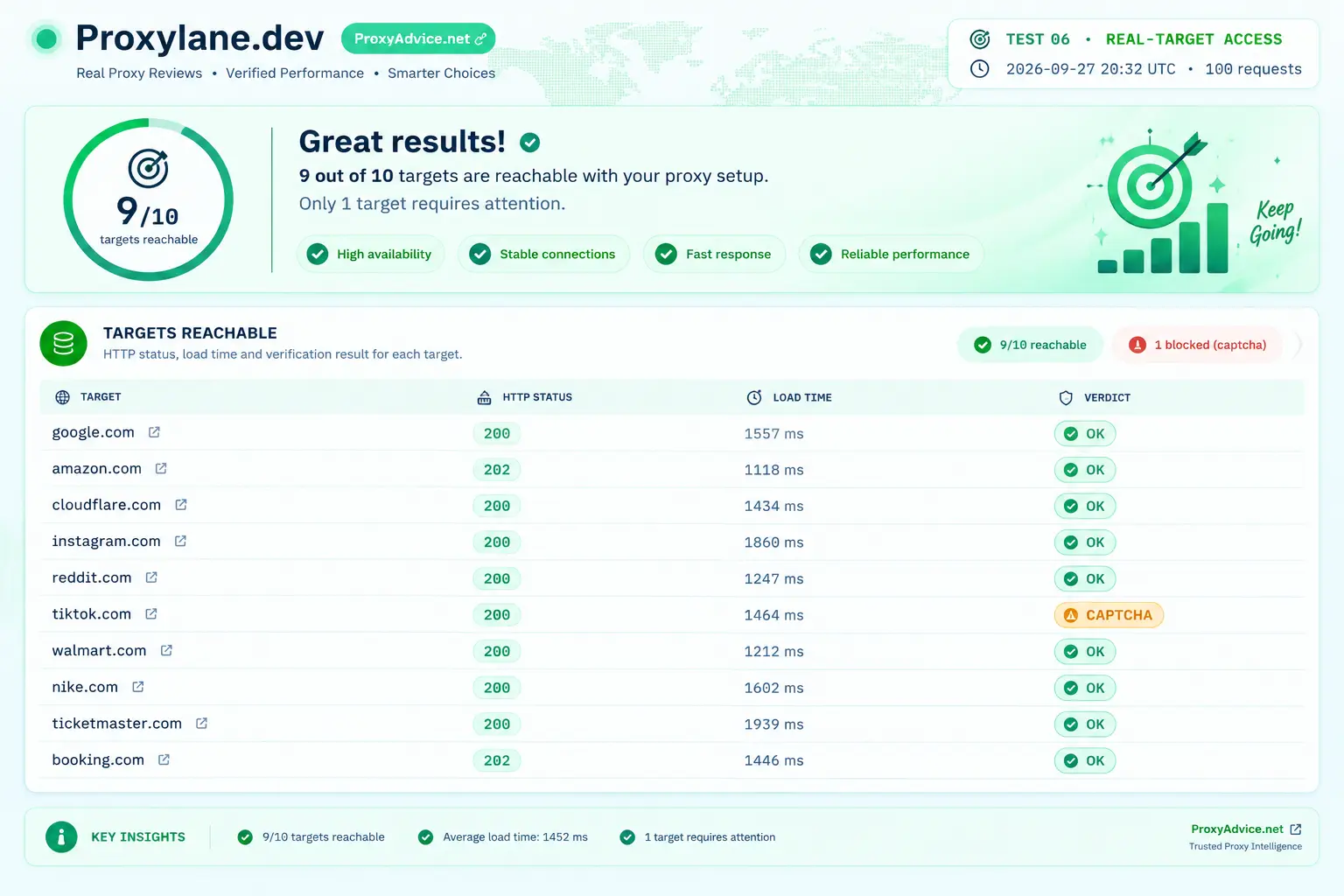
The summary scorecard came back A+ 92/100. 100% success (100/100 requests completed, zero timeouts, zero failures), 1081ms median latency, 1130ms mean, 1563ms P95, min 915ms, max 1977ms. Three unique exit IPs recorded across the run, marked as Stable by the test harness. Anonymity was Elite: real IP fully masked, exit IP differed on every check, zero proxy-identifying headers leaked (no Via, no X-Forwarded-For, no Forwarded). Target access came in at 9/10, with TikTok returning a CAPTCHA challenge under the default proxy setup — the other 9 targets (Google, Amazon, Cloudflare, Instagram, Reddit, Walmart, Nike, Ticketmaster, Booking) all returned HTTP 200/202 cleanly.
The response-time distribution was tight. Most requests fell in the 980-1113ms band, with 38 requests in the 980-1046ms bucket and 36 in the 1047-1112ms bucket. The 95th percentile at 1563ms and the maximum at 1977ms both stayed well under the 20s timeout, and the mean-vs-median gap (1130ms vs 1081ms) shows a distribution without heavy outliers. For a residential pool routing real device traffic to varied targets, this is a healthy shape.
| Metric | Result | Notes |
|---|---|---|
| Success Rate | 100.0% (100/100) | Zero timeouts, zero connection failures |
| Average Response | 1,130 ms | Minimum observed: 915 ms |
| Median Response | 1,081 ms | Typical request time |
| P95 Response | 1,563 ms | Maximum observed: 1,977 ms |
| Unique Exit IPs | 3 (Stable) | Across a single-session sticky test run |
| Anonymity Score | Elite · No leaks detected | Header inspection: zero proxy-identifying leaks |
| Target Access | 9/10 reachable | TikTok returned a CAPTCHA at 1464 ms |
Why Does ProxyLane Stand Out?
Six Platform Advantages That Actually Matter
Below are the six areas where ProxyLane does something meaningfully different, not just marketing points, but features that changed how I would use it in real workflows.
Traffic Never Expires
Buy 50 GB, use 12, pause for a month, come back to your remaining 38 GB. Unused traffic carries over indefinitely on every plan — not just enterprise tiers.
28M+ IPs Across 195 Countries
One of the widest country footprints in the residential market. 230 locations, including islands, with country, city, ISP, ASN, and ZIP targeting on qualifying regions.
Unlimited Concurrent Connections
No account-level throttle on parallel jobs. Push 100+ threads at your scraper without hitting a per-plan concurrency cap that would slow you down.
24/7 Human Support
Chat, email, Telegram, and Discord — all monitored around the clock by real humans. No chatbot triage, no ticket queue for basic setup questions.
MCP Access for AI Agents
Managed interface for Claude, Cursor, ChatGPT, and any MCP-compatible client. Requests carry explicit URL, region, and budget — designed for agent workflows.
No KYC · Crypto Payments
Sign up and start using in about 30 seconds. Pay with Visa, USDC, USDT, or 25+ other crypto options. Accessible for cross-border and privacy-conscious buyers.
ProxyLane Pros & Cons: The Unfiltered Take
Everything below reflects what I actually saw across 30 days on the platform. Advantages are backed by measured data. The limitations are real and worth knowing before you spend.
Advantages
Real Limitations
Which Tasks Is ProxyLane Best For in 2026?
Matching Proxy Type to Use Case
ProxyLane’s product page leads with scraping and browser automation, and my 30 days of testing confirmed those are the strongest fits. Below is where the residential pool earns its place based on real workloads, and where you should pair it with a second provider.
For workflows that need datacenter throughput, dedicated static residential, or ISP proxies for account-attached tasks, pair ProxyLane with a second provider. See our 2026 proxy provider guide for datacenter and ISP alternatives.
Parallel scraping jobs benefit from unlimited concurrent connections and rotating residential IPs. Python Requests, Scrapy, and n8n workflows all connect with a one-line proxy config.
Playwright and Puppeteer with sticky sessions (up to 7 days, device-dependent) keep the same exit through a multi-step flow. Full HTTP/HTTPS support integrates cleanly with existing scripts.
Country and city targeting simulates real shoppers on Amazon, Shopify, eBay, and marketplace targets. Rotating IPs across storefronts keep price sweeps clean.
Location-accurate SERP checks across 195 countries. ISP-level targeting adds precision where regional SERPs vary by network.
Per-profile sticky sessions for browser profiles running Meta, Google Ads, or TikTok campaigns. Larger packages drop the effective per-GB cost.
MCP access lets Claude, Cursor, ChatGPT, or custom agents route public-web page requests through residential IPs with explicit region and budget controls.
How Is ProxyLane’s Support and Infrastructure?
What I Actually Got When I Reached Out
ProxyLane runs support across four channels: in-app chat, email, Telegram, and Discord. Every channel is staffed by human operators around the clock, not a chatbot triage layer. I opened three support conversations during the review period: one on Telegram about location availability for a specific city, one on the in-app chat about SOCKS5 authentication for Playwright, and one on Discord about the sticky-session behavior when a residential device drops mid-flow.
Response times were consistently under an hour. The Telegram question about city-level availability came back in about 25 minutes with the exact ISP options available in the location I asked about. The Playwright SOCKS5 question came back in 42 minutes with a working proxy URL format and a link to the Playwright integration guide. The Discord sticky-session question was answered in real time with the technical detail: sticky sessions carry the same exit as long as the underlying residential device stays online, so the session ends if the device goes offline, and your automation should be designed to recover cleanly.
The ProxyLane dashboard is functional and unfussy. The overview panel shows plan status, remaining GB, and daily usage. Location controls let you pick country, region, city, and ISP through a searchable selector. Saved proxy lists per project mean you keep configurations reusable across runs. Exports drop straight into the format your existing tool (browser, scraper, antidetect) expects. The documentation library covers Playwright, Python Requests, cURL, and n8n with working code samples.
Response Quality
Working code samples, technical accuracy
Avg Response
Under 45 min in our tests
Docs
Playwright, Python, cURL, n8n guides
Free Tools
IP checker, proxy tester, header inspector
ProxyLane FAQ: People Also Ask
Final Verdict: Is ProxyLane Worth It in 2026?
Yes, if your workflow is residential-heavy and you value flexible spend. The A+ 92/100 test result is real: 100% success on 100 requests, 1081ms median latency, Elite anonymity, and 9/10 real target sites reachable on the first pass. Non-expiring traffic, unlimited concurrent connections, and a $1.95 trial with no KYC are genuine differentiators. The caveats: no datacenter, no ISP, no static residential, no mobile, and TikTok needed extra work at the browser layer. For scraping teams, browser automation workloads, and location-based monitoring, ProxyLane earns the recommendation. For product breadth or dedicated static IPs, keep a second provider in the mix.