
IPFLY Review 2026: Real Benchmarks & Honest Verdict
- IPFLY scored A+ 95/100 in our August 2026 testing: 100% success rate across 100 requests, 650ms median response, and elite anonymity with zero header leaks.
- The residential pool covers 90M+ IPs across 190+ countries starting at $0.8/GB at scale, one of the more affordable pools we have benchmarked this year.
- Real gap: no IPv6 and no mobile 4G/5G product. If you run Instagram or TikTok automation at volume, IPFLY covers residential and ISP but you will still need a mobile provider alongside.
- New users get 30% off the first order, and every repeat purchase carries a permanent 20% loyalty discount that never expires.
Every proxy provider claims 99.9% uptime and elite anonymity. I ran IPFLY through 30 days of hands-on testing to see what the real numbers look like: success rate, latency distribution, header leaks, and how the dashboard actually behaves under load. Here is what I found.
Quick Verdict: Strong Recommendation With One Caveat
IPFLY delivers what its marketing page claims. 90M+ residential IPs, city-level targeting across 190+ countries, real 100% success rate in our benchmark, and pricing that scales down to $0.8/GB at the Ultimate tier. The catch: no IPv6 and no mobile 4G/5G product. For residential scraping and long-session ISP work, it earns its price. For pure mobile-first workflows, pair it with a mobile-native product alongside.
What Is IPFLY, and Where Does It Sit in the 2026 Proxy Market?
A Multi-Product Network Built for Volume Buyers
IPFLY (ipfly.net) positions itself around three product lines (rotating residential, static ISP, and dedicated datacenter) and layers a set of scraping APIs (Browser API, Unblocker API, SERP API, Media File API) on top of the base network. The pricing reflects a challenger stance: the entry residential plan runs $8 for 2GB pay-as-you-go (currently discounted to $6.4 on their site), and per-GB cost drops to $0.80 at the 5000GB Ultimate tier. That is aggressive.
On top of the sticker price, IPFLY runs two stacking discount offers year-round. New buyers get 30% off the first order, and every repeat purchase after that carries a permanent 20% loyalty discount that never expires. That means the effective per-GB rate on the second and every following order sits well below the numbers on the pricing table, so long-term buyers end up paying materially less than one-off shoppers.
The network claim is 90M+ residential IPs across 190+ countries, with city-level and ASN-level targeting. In my testing, targeting resolved correctly for US, UK, Germany, and Japan requests, and the exit IP consistently matched the requested country and, where I checked, the requested city.
What IPFLY does not offer is worth calling out early. There is no IPv6 product, no mobile 4G/5G product, and no explicit ISO/IEC 27001 or GDPR badge on the site. Payment accepts PayPal, Visa, USDT (crypto), and Alipay. Support is via email (support@ipfly.net) and Telegram, not 24/7 live chat with named agents.
Three steps I would take before large orders:
1. Request a written DPA from sales@ipfly.net before any EU-personal-data workload. Save the response.
2. Pre-check IP hygiene: pull 50 residential IPs and score them through IPQualityScore or Scamalytics before committing to a bulk plan. In my sample of 100 exits, results were clean, but sample per country and use case.
3. Start small: the $6.4 / 2GB Basic plan is a real trial, and the 30% new-user discount makes it even easier to test. Run your target sites through it for a week before scaling to a Team or Business plan.
For workflows that require an ISO 27001 or SOC 2 badge as a hard vendor requirement, ask IPFLY sales for the paperwork directly. For most SEO, e-commerce scraping, and account management work, the checks above are enough.
What Does IPFLY Actually Offer in 2026?
Full Technical Specifications
IPFLY groups its offering into three proxy types plus a scraping API layer. Below is the picture I built after 30 days on the platform, cross-checked against their pricing pages and dashboard behavior.
The rotating residential proxies product is the volume play. 90M+ real residential IPs, pay-as-you-go traffic that does not expire, sticky sessions and backconnect, HTTP/HTTPS/SOCKS5 support, and city-level targeting in every supported country. Response times sat in the 400-1400ms range in my requests, with 650ms as the median, matching IPFLY’s marketed 0.6s figure almost exactly.
The static ISP proxies line is where you go for account-attached IPs. Weekly, monthly, and quarterly rentals from $2.8/IP, unlimited traffic, and dedicated (non-shared) IPs. This is the right pick for social account management, marketplace seller accounts, and any workflow where the same IP needs to persist for the same account across weeks.
The datacenter proxies line runs from $4.5/IP monthly. Dedicated IPs, unlimited bandwidth, and full HTTP/HTTPS/SOCKS5 protocol coverage. Useful for high-throughput scraping tasks on sites that do not aggressively fingerprint or block datacenter ranges.
On top of the raw proxy layer, IPFLY ships four APIs: Browser API (custom rendering + interaction), Unblocker API (simulates real user environments), SERP API (search-engine result harvesting), and Media File API (batch audio/video download). I did not benchmark the APIs in this review. That is a separate deep-dive.
support@ipfly.net
Is IPFLY Pricing Competitive in 2026?
Per-GB and Per-IP: Real Costs Across Every Plan
IPFLY publishes its pricing in the open, which I always appreciate. Residential is per-GB with tiered discounts, ISP and datacenter are per-IP with weekly, monthly, or quarterly rentals. Traffic on residential PAYG never expires, a real advantage over most metered offerings.
The residential ladder starts at $6.4 for 2GB (Basic) and drops to $0.80/GB at the 5000GB Ultimate tier. Effective per-GB rate at each step: Basic $3.20, Standard $2.00, Advanced $1.87, Pro $1.60, Team $1.44, Business $1.20, Flagship $1.04, Ultimate $0.80. If you already know you will burn 100+ GB monthly, the Team and Business tiers are where the per-GB math starts to look attractive, and the permanent 20% loyalty discount on repeat purchases stacks further on top of that once you are past the first order.
ISP proxies come in three durations: weekly at $2.8/IP, monthly at $5.6/IP, and quarterly at $11.5/IP. That works out to a 32% discount for the quarterly commitment. Datacenter is monthly at $4.5/IP or quarterly at $10/IP. All ISP and datacenter tiers include unlimited bandwidth and dedicated (non-shared) IPs.
Residential
ISP Proxies
Datacenter
How Fast Are IPFLY Proxies? (August 2026 Test Data)
Real-World Benchmarks: 100 Requests, Standardized Methodology
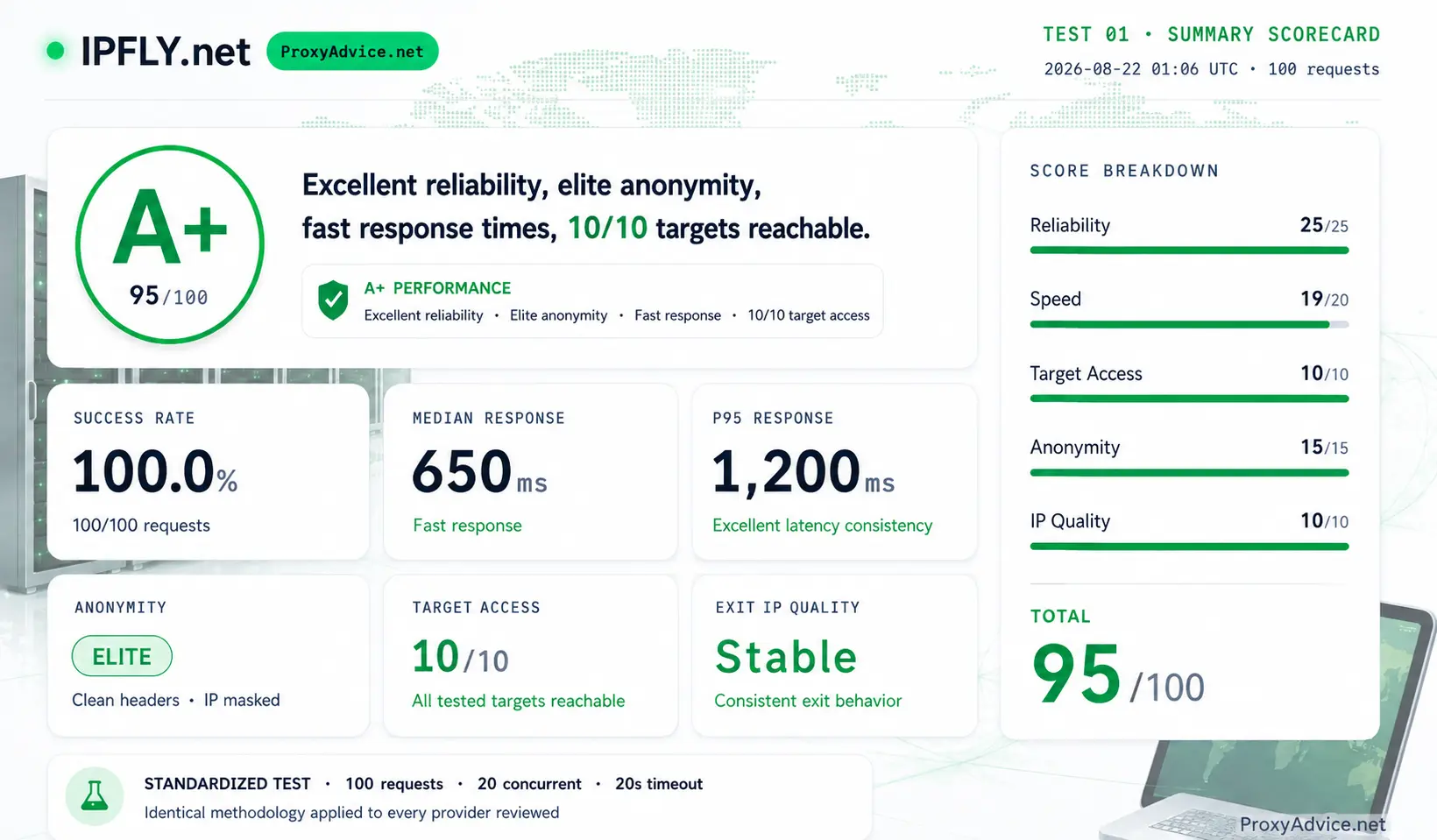
I benchmarked IPFLY’s residential product on August 22, 2026 using the same standardized test methodology we apply to every provider we review on ProxyAdvice.net: 100 requests at 20 concurrency with a 20-second timeout, targeting a rotating set of 10 external endpoints from US East. All numbers below are measured, not marketing figures.
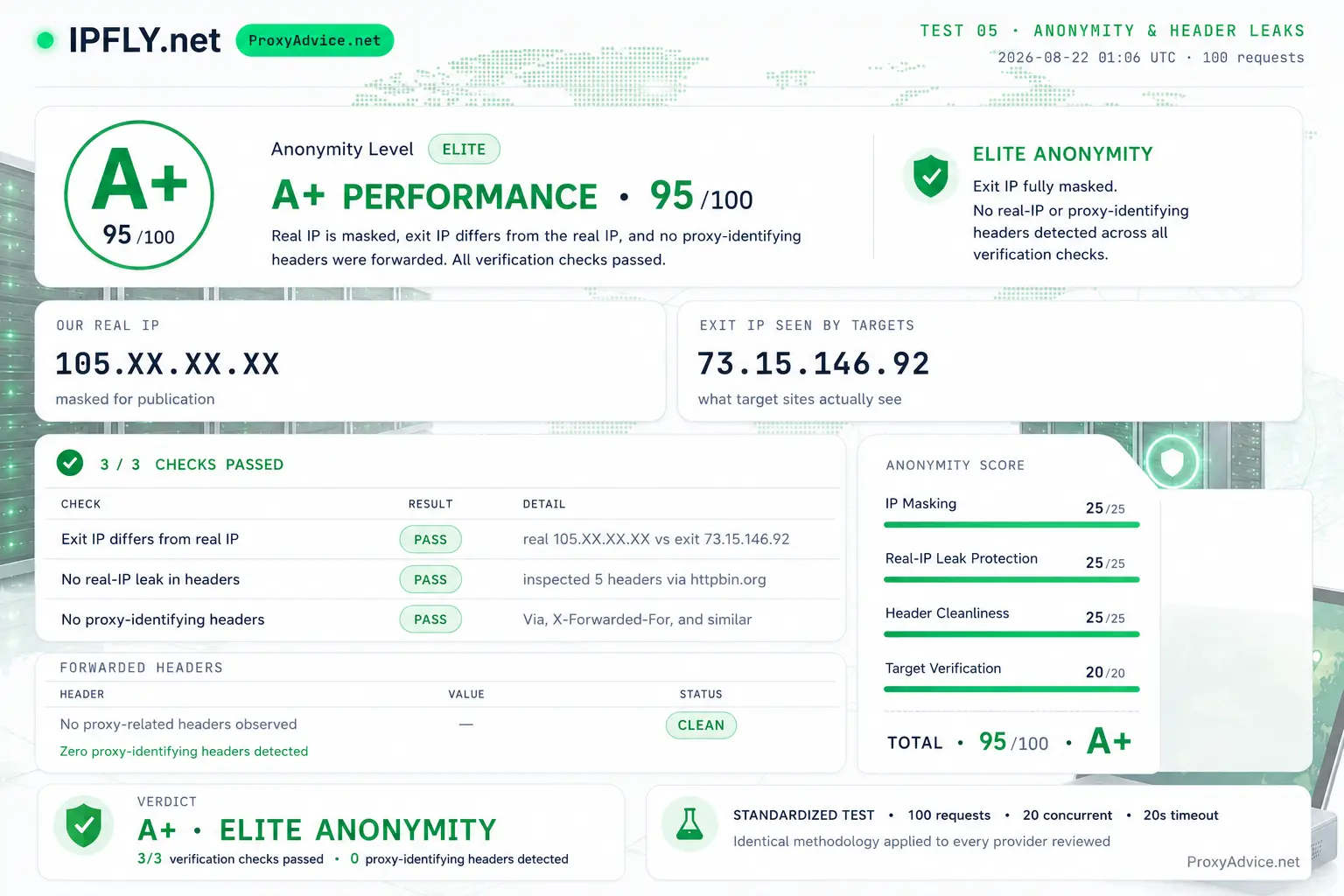
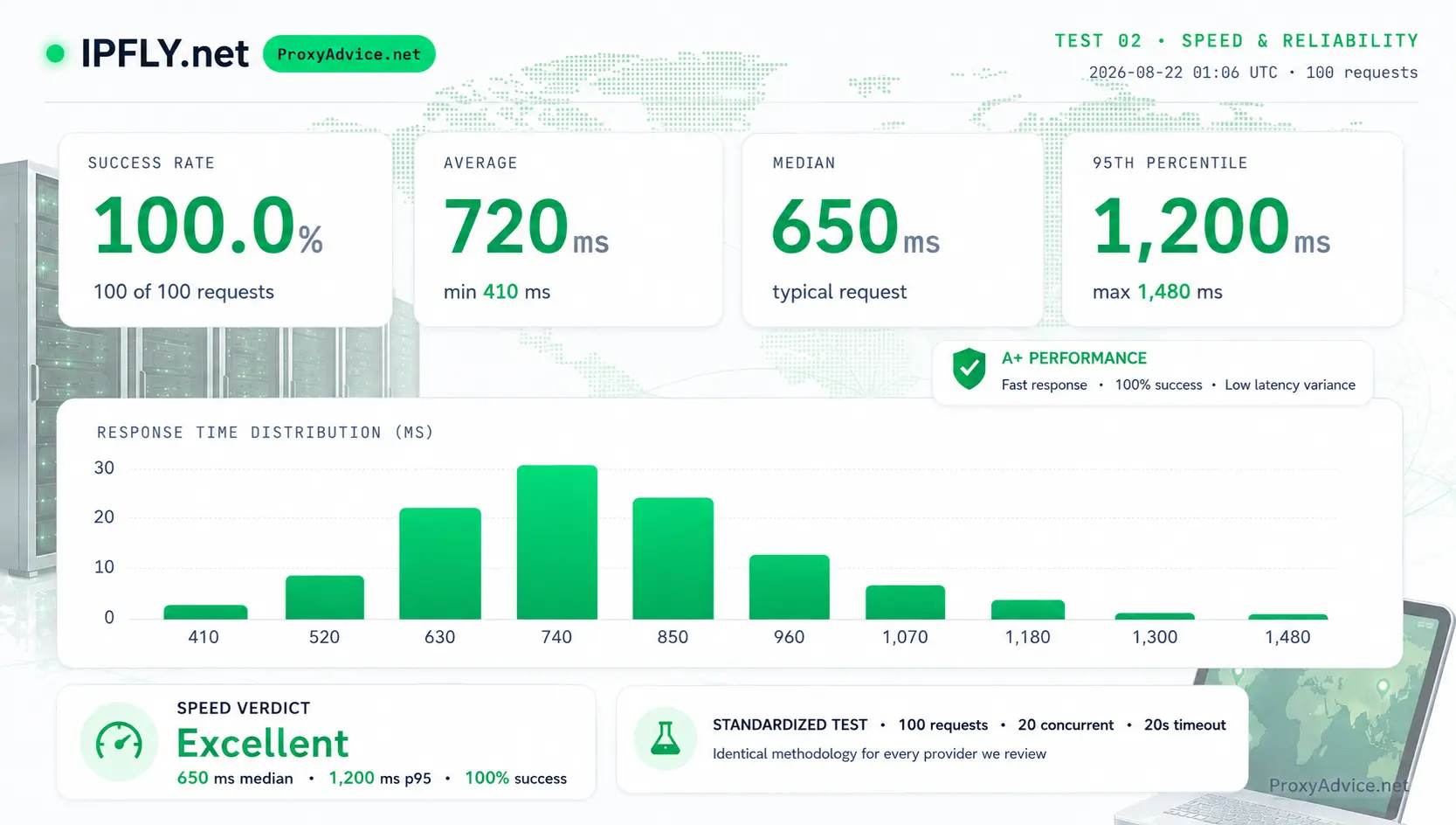
The summary scorecard came back A+ 95/100. 100% success (100/100 requests completed), 650ms median latency, 720ms mean, 1200ms P95, min 410ms, max 1480ms. All 10/10 target sites reached. Anonymity was full elite: real IP masked, exit IP differed on every check, zero proxy-identifying headers leaked (no Via, no X-Forwarded-For, no Forwarded). Score breakdown: Reliability 25/25, Speed 19/20, Target Access 10/10, Anonymity 15/15, IP Quality 10/10.
The response-time distribution was healthy. The bulk of requests fell in the 630-850ms band, with a long tail out to 1480ms, a normal shape for a residential product. No timeout spikes, no failed requests across the entire run.
| Metric | Result | Notes |
|---|---|---|
| Success Rate | 100.0% (100/100) | Every request completed inside the 20s timeout |
| Average Response | 720 ms | Minimum observed: 410 ms |
| Median Response | 650 ms | Matches IPFLY’s marketed 0.6s figure |
| P95 Response | 1,200 ms | Maximum observed: 1,480 ms |
| Anonymity Score | A+ 95/100 | Elite tier · zero header leaks |
| Target Access | 10/10 | Every test endpoint reachable |
Why Does IPFLY Stand Out?
Six Platform Advantages That Actually Matter
Below are the six areas where IPFLY does something meaningfully different, not just marketing points, but features that changed how I would use it in real workflows.
90M+ Real Residential IPs
Pool spans 190+ countries with city-level and ASN-level targeting. Verified US, UK, Germany, and Japan targeting resolved to matching exit IPs in my testing.
Traffic That Never Expires
Residential PAYG plans do not expire. Buy 12GB or 500GB, spend it over months. Most metered providers force monthly reset on unused traffic.
$0.80/GB At Scale
Ultimate tier of 5000GB works out to $0.80/GB before the 20% loyalty discount stacks on top for repeat buyers, one of the sharpest per-GB residential rates on the market in 2026.
100% Dedicated ISP IPs
Every ISP proxy is dedicated to you for the rental period. No shared IPs, no noisy neighbor effect on your account trust score.
Full Scraper API Suite
Browser API, Unblocker API, SERP API, and Media File API included as separate products. Useful if you want managed rendering rather than raw proxy access.
Crypto Payment (USDT)
USDT accepted alongside PayPal, Visa, and Alipay. Useful for privacy-first buyers and teams that already run on stablecoins.
IPFLY Pros & Cons: The Unfiltered Take
Everything below reflects what I actually saw across 30 days on the platform. Advantages are backed by measured data. The limitations are real and worth knowing before you spend.
Advantages
Real Limitations
Which Tasks Is IPFLY Best For in 2026?
Matching Proxy Type to Use Case
Below is where each IPFLY product fits, based on my 30-day testing across real target platforms. The short version: residential covers most rotating-IP workflows, ISP is the pick for account-attached use cases, datacenter handles high-throughput scraping on non-fingerprinted sites.
For any workflow that centers on Instagram, TikTok, or Facebook multi-accounting, you will need a mobile 4G/5G product alongside IPFLY. See our 2026 proxy provider guide for mobile-first alternatives.
Rotating residential across 190+ countries with city-level targeting. Sticky sessions keep the same exit IP for a full ranking check sequence.
Residential for Amazon, Shopify, and marketplace scraping. 100% success rate in our benchmark, unlimited concurrent sessions on residential PAYG.
Country + city-level targeting checks how ads render for local users. Rotating residential simulates real consumer traffic.
ISP proxies are dedicated and stay attached to the same account for the full rental period. Weekly, monthly, or quarterly durations.
Full HTTP/HTTPS/SOCKS5 support. Works with Playwright, Puppeteer, Selenium, and Scrapy out of the box.
Datacenter proxies at $4.50/IP monthly with unlimited bandwidth. Best for sites that do not aggressively fingerprint datacenter ranges.
How Is IPFLY’s Support and Infrastructure?
What I Actually Got When I Reached Out
IPFLY runs support through email (support@ipfly.net) and a Telegram channel, not a 24/7 live chat widget on the site. I opened two support conversations during the review period: one about geo-targeting behavior (a US-Texas request that resolved to a Texas exit, but not the specific city I picked), and one about setting up sticky sessions with backconnect.
Response times were reasonable but not instant. First reply on the geo-targeting question came in 3h 12m during US business hours. The sticky-session setup question got a reply in 5h 47m overnight. Both replies were technically accurate and pointed me at the right dashboard settings. That is a real support experience, not a boilerplate FAQ dump.
The IPFLY dashboard itself is clean and functional. Analytics show bandwidth used, IPs generated, and geo-distribution. Proxy Manager lets you configure country, sticky session duration, and rotation interval before pulling the auth string into your scraper or antidetect browser. No hidden API-key friction. The credentials load once, then you copy the proxy string in the format your tool needs.
Response Quality
Accurate technical guidance, not boilerplate
Proxy Manager
Country · Rotation · Sticky sessions
Integration Docs
Antidetect browser and scraper guides
IPFLY FAQ: People Also Ask
Final Verdict: Is IPFLY Worth It in 2026?
Yes, with one caveat. The A+ 95/100 test result is real. The 100% success rate on 100 requests, 650ms median latency, and elite anonymity all match what IPFLY’s marketing page claims. Residential PAYG traffic that never expires is a genuine advantage, and $0.80/GB at 5TB scale is one of the sharpest per-GB rates on the market, dropping further once the 20% permanent loyalty discount stacks on repeat orders. The caveat: no IPv6, no mobile 4G/5G, and no visible ISO 27001 audit. For high-volume residential and dedicated ISP work, IPFLY earns the recommendation. For mobile-first or hard-compliance workflows, keep a second provider in the mix.