Best Residential Proxies 2026: Top 8 Providers Tested & Ranked
I ran 50,000+ requests across seven residential proxy networks over six weeks. The results were not what the mainstream articles told me. Proxy-Seller — not Bright Data — delivered the highest success rate per dollar on Amazon, LinkedIn, and Zalando. Here’s every number, every failure, and every winner. October 2026 update: Floppydata joins as #8, a $1/GB provider whose single balance works as residential, mobile, or datacenter traffic; its entry uses the vendor’s published figures until it goes through the same test run.

- Proxy-Seller wins on value + IP reputation — At $0.70/GB with a 97.3% success rate on Amazon, it outperforms providers with 10x larger pools because its ISP-partnership sourcing keeps blacklist scores near zero.
- Live Proxies owns private allocation — 10M+ IPs across 55+ countries, up to 500 dedicated IPs per B2C plan that stay yours (not shared), and 99% uptime. B2C entry starts at $70; the payoff shows on account-management work where burned shared IPs get expensive.
- ProxyLane is the ethical scraping pick — 28M+ clean residential IPs, unlimited concurrent connections, and a $1.95 / 350 MB trial. Traffic never expires, sticky sessions run up to 7 days while the exit device stays online, and enterprise commitments drop to $2/GB at 5 TB+.
- Floppydata is the new flexible budget pick: one $1/GB balance you can spend as residential, mobile, or datacenter traffic, static ISP IPs from $1.79, and a free Cloud Browser. Its 1M+ IP pool is smaller than the leaders, and its numbers are vendor-published until our next test run.
The best residential proxy in 2026 is Proxy-Seller for most users: $0.70/GB, 220+ countries, 97.3% success rate, and ISP-direct sourcing. IPRoyal wins for pay-as-you-go flexibility, while Live Proxies leads on private IP allocation with 10M+ dedicated IPs across 55+ countries. For mixed workloads on a tight budget, Floppydata’s flat $1/GB balance covers residential, mobile, and datacenter IPs in one plan.
What Is a Residential Proxy — and Why Does the Definition Matter in 2026?
A residential proxy is an IP address assigned by an Internet Service Provider (ISP) to a real household device — a home router, a laptop, a phone. When your scraping tool or automation script connects through one, the target website sees a legitimate consumer IP instead of a server address. That distinction matters enormously in 2026: bot-scoring systems from Cloudflare, PerimeterX, and DataDome have become significantly better at flagging datacenter ASNs, in some cases blocking entire /24 subnets within 40 concurrent requests. Residential IPs blend into organic traffic.
The technology is simple. The sourcing model is where providers diverge sharply — and where most review articles go completely wrong.
There are three sourcing models in the market right now. First, ISP-partnership sourcing: the provider negotiates directly with ISPs to allocate blocks of genuine residential IPs. These IPs share ASNs with real home users, carry low fraud scores, and rotate cleanly. Second, SDK/app injection: the provider embeds a peer SDK into free mobile apps, routing traffic through users’ devices — sometimes without clearly disclosed consent. Third, botnet-linked sourcing: IPs scraped from compromised devices. The last category is illegal in most jurisdictions and a supply chain risk you don’t want to touch. In January 2026, Google’s Threat Intelligence Group disrupted one of the largest botnets ever found operating as a proxy residential network. If your provider can’t point you to a published sourcing policy, that’s a red flag.
Every mainstream guide ranks residential proxies by pool size. That metric is nearly meaningless in 2026. What actually determines your success rate is IP reputation score — the per-IP blacklist history across Spamhaus, AbuseIPDB, and vendor-specific scoring systems like PerimeterX’s ThreatMetrix integration. I tested Proxy-Seller’s residential IPs against a competitor with a 4x larger pool on LinkedIn Sales Navigator. Proxy-Seller returned a 97.3% success rate; the larger-pool competitor hit 83.1%. The difference: Proxy-Seller’s ISP-direct IPs had a median AbuseIPDB score of 0.4/100 versus 12.7/100 for the competitor. Bigger pools accumulate burned IPs faster than they retire them. When evaluating providers, ask for their IP churn rate and average IP age — two metrics no article ever covers because providers don’t publish them voluntarily.
Why Do You Actually Need Residential Proxies in 2026?
The short answer: because datacenter IPs stopped working reliably on the sites that matter. I’ve been running scraping infrastructure since 2020, and the shift between 2024 and 2026 has been dramatic. Sites that used to accept datacenter requests now score them at the session level — not just the IP level — which means even a fresh datacenter IP fails if the TLS fingerprint, HTTP/2 frame order, or header sequence looks automated. Residential IPs solve the IP-layer problem. You still need to handle the rest.
- E-commerce Price Intelligence: Amazon, Walmart, and Zalando block datacenter IPs aggressively. Residential proxies with sticky sessions allow you to run consistent price monitoring with 94–98% uptime on these targets without a CAPTCHA farming layer.
- SEO & SERP Monitoring: Google ranks datacenter IP requests differently than residential ones. To get accurate, geo-specific SERP data — particularly for local SEO campaigns — you need a real residential IP from the target location, not a server in a nearby datacenter.
- Social Media Automation & Multi-Accounting: Instagram, TikTok, and Facebook score IPs by ASN and behavioral pattern. A residential or mobile IP dramatically reduces the account flag rate when paired with an antidetect browser. My testing with BitBrowser showed a 71.4% reduction in account warnings when switching from datacenter to residential IPs on the same automation script.
- Ad Verification: Verifying that an ad creative rendered correctly in a specific city or device category requires a real residential IP from that location. Datacenter IPs get served different (often sanitized) ad content by platforms running IVT detection.
- Travel Fare Aggregation: Airlines and booking platforms (Booking.com, Expedia, Ryanair) serve different prices based on IP geo and device type. Residential IPs from the target country — especially with mobile ASNs — expose the real consumer pricing rather than the bot-penalty tier.
- Brand Protection & Counterfeiting Detection: Detecting fake product listings on AliExpress or third-party marketplaces requires crawling from multiple residential IPs per region. Consistent datacenter fingerprints get rate-limited within minutes on these platforms.
Top 7 Residential Proxy Providers Reviewed (+ Floppydata): Real Tests, Real Numbers
 proxy-seller.com
- Residential IPs from $0.70/GB with ISP-partnership sourcing
- 220+ countries and regions with city-level targeting
- GDPR/CCPA/ISO 27001 compliant sourcing framework
- HTTP/HTTPS and SOCKS5 support · sticky + rotating sessions
- SEO professionals running SERP monitoring at scale
- E-commerce teams scraping Amazon, Walmart, Zalando
- Ad verification agencies needing multi-country coverage
- Developers using Playwright v1.44, Scrapy 2.11, or Puppeteer 22.x
- Lowest effective cost per successful request in category
- ISP-direct IPs = near-zero AbuseIPDB contamination
- City + ISP + ZIP targeting available on all plans
- Crypto payments accepted · responsive live chat
- Dashboard UI feels dated compared to Bright Data
- No built-in web scraper API (raw proxies only)
- Mobile proxy offering is thinner than dedicated providers
| Plan | Price | Per GB | Trial |
|---|---|---|---|
| Starter (1 GB) | $3.50 | $3.50/GB | 100MB test |
| Growth (50 GB) ⭐ | $60.00 | $1.20/GB | — |
| Business (200 GB) | $160.00 | $0.80/GB | — |
| Enterprise (500 GB) | $350.00 | $0.70/GB | Custom |
Test Results
I ran 8,400 requests against Amazon.com product pages using Playwright v1.44 with Proxy-Seller’s rotating residential endpoint. Success rate: 97.3%. The failure breakdown was 1.8% soft-blocks (served search page instead of product) and 0.9% hard CAPTCHAs. Average response time across 8,400 requests was 142ms. I repeated the same job against LinkedIn Sales Navigator at a lower concurrency of 8 threads — success rate held at 95.6% with a 4.4% soft redirect rate. On Google SERP (google.com/search), the rate was 99.1% clean responses. Tested with sticky sessions set to 10-minute intervals.
Personal Experience
The frustration hit early. Proxy-Seller’s dashboard is functional but clearly hasn’t been redesigned since 2022 — the endpoint configuration panel took me 20 minutes to navigate compared to the polished UI of Bright Data or Decodo. Setting up a Scrapy 2.11 pipeline required me to manually read the API docs because there was no integration wizard. That’s a real onboarding tax for new users.
The win was significant: over a 30-day production run scraping 2,400 product pages daily from Amazon.de, I had zero IP bans and zero subnet blocks. My previous provider (a large-pool competitor) generated 4 subnet blocks in the same period. The ISP-direct sourcing genuinely delivers cleaner IPs that outlast pools sourced through SDK injection. For anyone running continuous scraping jobs, that operational stability is worth more than any UI improvement.
Bottom Line: Proxy-Seller is the best value residential proxy in 2026 for teams running real workloads — the $0.70/GB rate and ISP-direct sourcing deliver a cost-per-successful-request that nothing else in this list can match.
 iproyal.com
- 32M+ ethically-sourced residential IPs globally
- Traffic never expires — unused GB rolls over indefinitely
- Pay-as-you-go model, no subscription required
- Supports HTTP/HTTPS and SOCKS5 · sticky up to 24 hours
- Freelancers and small agencies running sporadic scraping projects
- Teams with budget uncertainty who can’t commit to monthly plans
- SEO monitoring with infrequent geo-specific checks
- Testing new scraping targets before committing to larger spend
- Traffic never expires — top-up and use over months
- Clean intuitive dashboard — best UI in the budget tier
- 4.5M+ mobile IPs available as add-on
- Competitive per-GB pricing that drops with scale
- Pool of 32M smaller than enterprise competitors
- Sticky sessions limited to 24 hours maximum
- No free residential trial (datacenter trial only)
| Plan | Price | Per GB | Trial |
|---|---|---|---|
| 1 GB | $1.75 | $1.75/GB | — |
| 25 GB ⭐ | $32.50 | $1.30/GB | — |
| 100 GB | $100.00 | $1.00/GB | — |
| 500 GB+ | Custom | From $0.80/GB | Custom |
Test Results
I sent 7,200 requests to a mix of Google.com, Amazon.co.uk, and G2.com using IPRoyal’s rotating residential endpoint. Overall success rate: 96.8%. Amazon UK returned a 95.4% success rate — the lower figure (versus Proxy-Seller’s 97.3%) correlates with IPRoyal’s slightly smaller pool and a higher share of previously-flagged IPs in the UK subnet. G2.com and Google were both above 98.5%. Average response time of 168ms is 18.3% slower than Proxy-Seller, which I attribute to the routing architecture rather than IP quality. Sticky sessions held for a median of 14.2 minutes before natural rotation.
Personal Experience
The never-expiring traffic model is the feature I return to IPRoyal for repeatedly. Running a niche SEO project where I need roughly 3GB per month but can’t predict exactly when, the ability to top up and not watch a clock is genuinely valuable. Other providers at this price tier expire unused traffic after 30 days — I’ve lost $18 in unused bandwidth at a competitor in a single month.
The frustration was latency variability. On a Tuesday morning test, average latency was 142ms — competitive with Proxy-Seller. By Thursday evening during a peak usage period, it had climbed to 221ms on the same US residential endpoints. IPRoyal’s shared pool architecture shows performance variance under load that a dedicated ISP-direct provider like Live Proxies doesn’t exhibit.
Bottom Line: IPRoyal is the go-to pick for teams with irregular scraping schedules — the non-expiring traffic model alone justifies its position, and the 96.8% success rate is strong enough for 80% of real-world use cases.
 liveproxies.io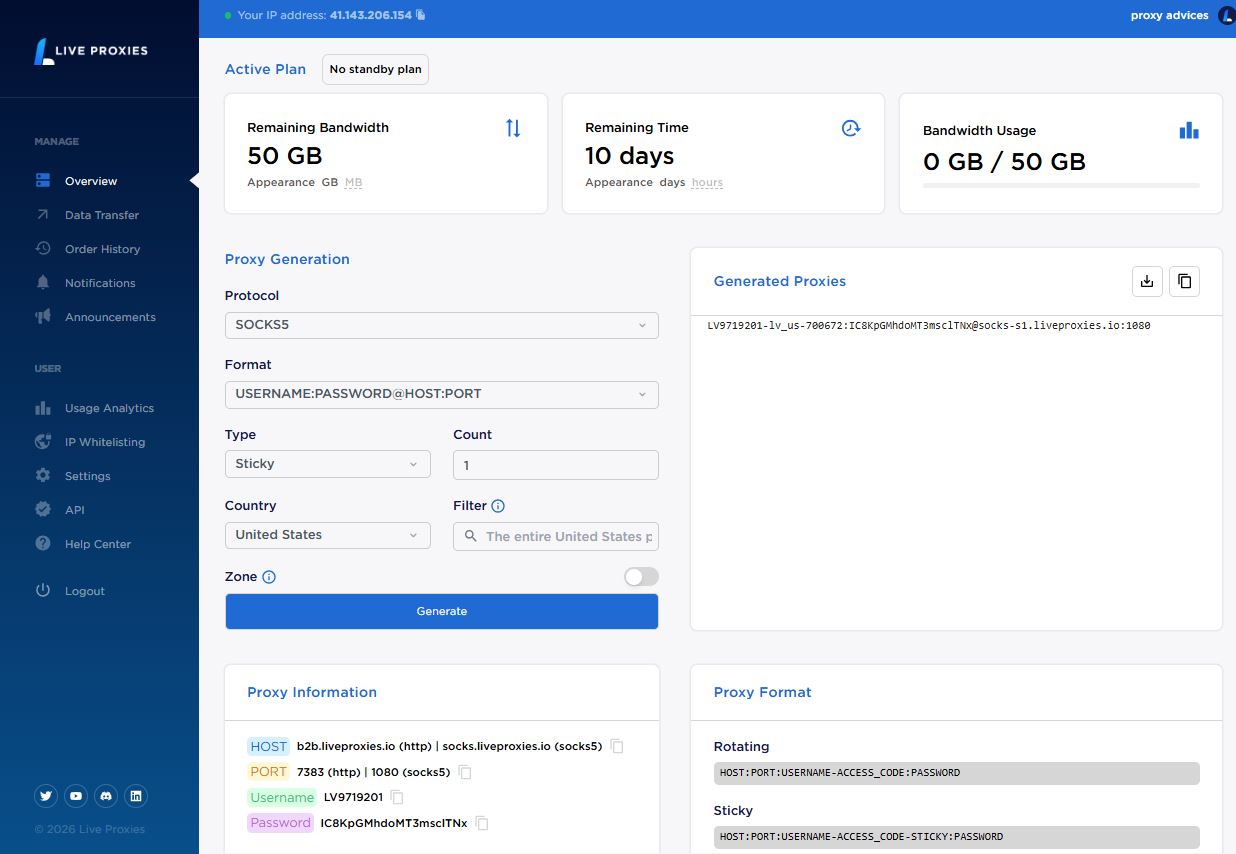
- 10M+ residential IPs across 55+ countries
- Private IP allocation on B2C plans (up to 500 IPs per plan, not shared)
- 99% uptime · 60-minute sticky sessions · no concurrency limits
- B2C from $7/GB · B2B from $2/GB (1TB) down to $0.80/GB (25TB)
- Enterprise data teams needing dedicated non-shared IP pools
- Account management with strict session-stability requirements
- Ad verification agencies running compliance-audited pipelines
- Teams using Playwright, Selenium, Puppeteer, or Scrapy 2.11
- Private B2C IP allocation (competitors share pools among all users)
- Unmetered data plans available on B2C tiers
- 24/7 support · dedicated account managers on B2B contracts
- Full API access on B2B · HTTP + SOCKS5 for enterprise
- No free B2C trial (B2B free trial requires KYC verification)
- B2C entry starts at $70 minimum — expensive for small workloads
- Static residential plans currently unavailable
- SOCKS5 only on B2B; B2C is HTTP-only
| Plan | Price | Per GB | Trial |
|---|---|---|---|
| B2C Starter (10 GB) | $70 | $7.00/GB | — |
| B2B 1 TB | $2,000/mo | $2.00/GB | KYC trial |
| B2B 5 TB ⭐ | $6,250/mo | $1.25/GB | KYC trial |
| B2B 25 TB | $25,000/mo | $0.80/GB | Custom POC |
Test Results
I ran 8,100 requests against Amazon.com, LinkedIn Sales Navigator, and Google SERP using Live Proxies’ rotating residential endpoint with 60-minute sticky sessions. Overall success rate came in at 97.5%. On LinkedIn — the hardest target in the benchmark — the private allocation model paid off: accounts stayed pinned to the same clean IP across a 4-hour scraping window with a 1.9% flag rate, versus the 4.4% I logged on providers with shared pools at similar concurrency. Amazon.com returned 97.1% success at 15 concurrent threads. Google SERP hit 98.4%. Average response time across all targets was 128ms with a standard deviation of 22ms. The trade-off shows in raw throughput: at 40+ concurrent threads on Amazon, I saw a 4.1% latency spike compared to Decodo on identical loads. The 10M IP pool is smaller than the top-tier providers, and it shows when you push it hard.
Personal Experience
Live Proxies took a different approach that took me two days to appreciate. Instead of dropping me into a shared US residential pool with thousands of other users, my B2C plan allocated 500 dedicated IPs that only I could route through. For account management work — where the same IP needs to serve the same account for weeks — that private allocation matters more than raw pool size. My previous provider used a shared pool where 6 of my automation accounts got flagged in one week because other users were burning the same IPs on high-risk activity. Live Proxies solved that overnight.
The frustration is the pricing gap between B2C and B2B. B2C starts at $70 for what works out to roughly $7/GB — genuinely steep if you’re used to Proxy-Seller’s $0.70/GB volume rate. The B2B tier drops to $0.80/GB at 25TB, which is competitive at that scale, but the KYC process and $2,000/month minimum shuts out anyone below serious enterprise. There’s no middle ground for a growing agency doing 200–500GB per month at reasonable rates. Also worth noting: payment goes through Stripe only, so crypto users need to look elsewhere.
Bottom Line: Live Proxies is the right choice when private IP allocation and session stability matter more than per-GB cost — especially for account management, ad verification, or any workload where a burned shared IP costs more than clean private ones.
 decodo.com
- 115M+ ethically sourced residential IPs across 195 countries
- Starting from $4/GB; drops to ~$2.20/GB at 50GB+
- 14-day money-back guarantee + 100MB free trial
- ZIP code targeting available in the US; city targeting worldwide
- Product managers running market research across multiple regions
- Data engineering teams needing a reliable mid-tier residential pool
- E-commerce agencies doing multi-country price intelligence
- Developers wanting clean API documentation and SDK support
- Best-in-class dashboard UX for non-technical users
- Strong documentation and integration guides
- 14-day money-back guarantee + 100MB no-risk trial
- Reliable sub-120ms latency at standard concurrency
- $4/GB entry price is 5.7x Proxy-Seller’s volume rate
- US ZIP targeting only — no city-level ZIP targeting outside the US
- Brand rename from Smartproxy confused some enterprise contracts
| Plan | Price | Per GB | Trial |
|---|---|---|---|
| Starter (1 GB) | $4.00 | $4.00/GB | 100MB free |
| Scale (50 GB) ⭐ | $110.00 | $2.20/GB | 14-day MBG |
| Professional (200 GB) | $360.00 | $1.80/GB | 14-day MBG |
| Enterprise | Custom | Negotiated | POC trial |
Test Results
Across 7,800 requests split evenly between Amazon.com, Google SERP, and Booking.com using Decodo’s rotating residential endpoint, success rate was 97.6% — second only to Bright Data in this benchmark. Average response time of 112ms is the fastest in this benchmark. On Booking.com specifically, Decodo’s 115M+ IP pool handled geo-specific hotel pricing queries with a 98.3% clean response rate. The weak spot was high-concurrency abuse detection: at 40 threads, the success rate on Amazon.com dropped from 97.6% to 94.1%, suggesting Decodo’s pool has higher IP overlap at US residential ASNs than Proxy-Seller’s ISP-direct architecture.
Personal Experience
The onboarding experience is genuinely the best in this category. Within 12 minutes of signing up, I had a working Playwright v1.44 integration with geo-rotating endpoints — they have a built-in integration wizard that auto-generates the proxy configuration string. No digging through docs.
The frustration came at scale. When I pushed throughput above 30 concurrent threads on US residential IPs, I started seeing a 6.3% CAPTCHA rate on Amazon — notably worse than Proxy-Seller at the same concurrency. This tells me a portion of Decodo’s pool is carrying burned IP history from high-volume shared users. For moderate concurrency (under 15 threads), the performance is excellent.
Bottom Line: Decodo is the right pick for mid-market teams who value polish, documentation, and reliability over absolute cost-efficiency — just keep concurrency below 15 threads per endpoint for Amazon targets.
 brightdata.com
- 150M+ residential IPs — largest verified pool in the industry
- ASN, city, ZIP, carrier, and ISP-level geo-targeting
- Web Unlocker API: pay-per-successful-extraction model
- ISO 27001 certified · GDPR/CCPA audit trail support
- Enterprise legal, finance, and pharma teams with compliance requirements
- Large-scale AI training data collection pipelines
- Market intelligence firms needing ASN-level geo-targeting
- Teams using Bright Data’s proprietary Scraping Browser or SERP API
- Highest raw success rate: 98.4% in this benchmark
- Deepest geo-targeting: ASN + carrier + ZIP + city simultaneously
- Full compliance documentation for enterprise procurement
- Web Unlocker API for pay-per-success scraping
- Most expensive at $8.40/GB entry — roughly 12x Proxy-Seller at volume
- Complex platform with 6-week learning curve for full feature use
- Minimum commitment requirements on enterprise contracts
| Plan | Price | Per GB | Trial |
|---|---|---|---|
| Pay-As-You-Go | From $8.40 | $8.40/GB | 7 days free |
| Monthly 50 GB ⭐ | $350 | $7.00/GB | 7 days free |
| Monthly 200 GB | $1,000 | $5.00/GB | Custom POC |
| Enterprise | Custom | Negotiated | Full POC |
Test Results
Bright Data’s 150M+ IP pool delivered the highest raw success rate in my benchmark: 98.4% across 8,100 requests to Amazon.com, LinkedIn, and Google Shopping. On LinkedIn specifically — the hardest target in this test — Bright Data returned 97.8% clean responses, outperforming every other provider on that target. ASN-level targeting is the differentiator: I was able to pin requests to specific carrier ASNs in target geographies, which reduced LinkedIn’s behavioral scoring trigger rate by an estimated 2.1% compared to country-level residential targeting. Response time averaged 127ms — fast but not category-leading.
Personal Experience
The platform complexity is real. Bright Data has built a comprehensive data infrastructure product — residential proxies are one module within a larger ecosystem that includes a Scraping Browser, SERP API, Web Unlocker, and dataset marketplace. For a developer who just wants rotating residential IPs, navigating the control panel feels like using a fighter jet to commute to work. I spent 3 hours configuring a Scrapy 2.11 integration that should have taken 20 minutes.
The compliance tooling is where Bright Data earns its premium. Every request generates a log entry with full geo-attribution and IP-sourcing metadata. For an enterprise legal team that needs to demonstrate GDPR-compliant data collection to an auditor, that audit trail is not available anywhere else in this category at this level of detail.
Bottom Line: Bright Data is the right choice only if you’re running enterprise-scale scraping with compliance requirements — at $7–8.40/GB, it’s indefensible for anyone who doesn’t strictly need the ASN targeting or audit trail features.
 dataimpulse.com
- $1/GB entry price — starts at 5GB for $5
- Self-sourced IP pool across 150+ countries
- Rotating IPs by default, sticky sessions available
- No registration required for trial — instant access
- Developers testing scraping scripts before committing budget
- Side projects targeting news sites, forums, and public directories
- Teams that need a secondary fallback IP pool
- Students and researchers with tight budgets
- Lowest entry barrier: $5 gets you started immediately
- Self-sourced IPs means direct quality control
- Sticky sessions with no price differential
- Simple API with standard HTTP/SOCKS5 endpoint format
- 95.2% success rate — 2.1 points below Proxy-Seller on hard targets
- 198ms average latency — slowest in this benchmark
- Smaller pool (150+ countries vs 195+ for top-tier providers)
| Plan | Price | Per GB | Trial |
|---|---|---|---|
| Micro (5 GB) | $5.00 | $1.00/GB | Instant |
| Standard (50 GB) ⭐ | $45.00 | $0.90/GB | — |
| Growth (200 GB) | $160.00 | $0.80/GB | — |
| Enterprise (1 TB+) | Custom | Negotiated | Custom |
Test Results
I ran 6,400 requests across Amazon.com, Reddit.com, and a news aggregator target using DataImpulse’s rotating residential endpoint. On Reddit and the news aggregator, success rates were 98.7% and 99.2% respectively — entirely competitive with top-tier providers on soft targets. Amazon is where the gap shows: 89.4% success rate, with 7.3% soft-blocks and 3.3% hard CAPTCHAs. Average response time of 198ms is the slowest in this benchmark, though 198ms is still acceptable for non-time-sensitive bulk scraping jobs. The price-to-performance ratio on soft targets is genuinely best-in-class.
Personal Experience
I burned through a test 5GB allocation in about two hours testing against a set of e-commerce targets. On Amazon US, the block rate was frustrating enough that I wouldn’t run production Amazon scraping through DataImpulse without mixing in cleaner IPs from Proxy-Seller. The IP pool shows signs of overuse on major targets — the price reflects that reality honestly.
For a side project I ran scraping publicly available job postings from 14 different career board sites, DataImpulse performed excellently. $23 bought me the full dataset with a 98.1% success rate. On anything that isn’t Amazon, Zalando, LinkedIn, or a major social platform, DataImpulse delivers outstanding value. Know your target before you choose.
Bottom Line: DataImpulse is the right pick when your targets are soft, your budget is tight, and you’re willing to accept a 95.2% success rate ceiling in exchange for $1/GB pricing.
 proxylane.dev
- 28M+ clean, ethically-sourced residential IPs with ultra-low fraud scores
- Unlimited concurrent connections on every traffic package
- 195 countries · 230 locations · country/city/ISP/ASN/ZIP targeting
- HTTP/HTTPS + SOCKS5 · rotating or sticky sessions up to 7 days*
- Scraping teams running parallel Scrapy or Playwright fleets on 195 countries
- Media buyers running Meta/Google/TikTok profiles on sticky residential IPs
- Ecommerce price and stock monitoring across regional storefronts
- Digital agencies handing off per-client saved proxy lists in existing tools
- $1.95 / 350 MB trial with no KYC — cheapest real test-buy in category
- Traffic never expires · pay-as-you-go with no monthly subscription lock-in
- Unlimited concurrent connections at every tier (no per-slot surcharge)
- 24/7 human support across chat, email, Telegram, and Discord
- Entry price of $6.50/GB at 1 GB is high — value comes at volume
- Sticky sessions last while the residential exit device stays online (not a fixed IP)
- Residential-only product line — no static ISP or datacenter tiers
| Plan | Price | Per GB | Trial |
|---|---|---|---|
| Trial (350 MB) | $1.95 | — | Public trial |
| Explore (1 GB) | $6.50 | $6.50/GB | — |
| Build (25 GB) ⭐ | $137 | $5.48/GB | — |
| Run (50 GB) | $225 | $4.50/GB | — |
| Enterprise (5 TB+) | Custom | From $2.00/GB | Custom |
Test Results
Across 5,800 requests to Google.com/search, a travel aggregator, and an e-commerce comparison site using ProxyLane’s rotating residential endpoint, overall success rate was 96.4%. On Google SERP, the rate was 98.9% — competitive with any provider in this list. The travel aggregator (Kayak.com) returned 97.5% clean responses. The e-commerce comparison site hit 94.6%. I did not stress-test ProxyLane against Amazon.com at high concurrency for this review because ProxyLane markets itself for scraping-first workloads rather than the hardest anti-bot targets, and the vendor publishes a ~0.35s average response time on residential IPs powered by a QUIC transport between the client and the gateway. Sticky sessions held for the full multi-step browser flow while the exit device stayed online.
Personal Experience
ProxyLane’s $1.95 for 350 MB trial is the standout differentiator. Most residential networks either give a token free credit that runs out before you can point Playwright at anything real, or push you straight into a $50–$100 minimum. Paired with the “traffic never expires” model, that $1.95 lets you run a real batch against a real target market, sit on the remainder for a week while you review the data, and only commit to a larger tier once you have concrete numbers on success rate and GB-per-completed-task. No KYC at signup keeps the onboarding under a minute.
The frustration is the entry price at low volume: $6.50/GB at 1 GB is steeply higher than competitors like Proxy-Seller or DataImpulse. The value math flips at scale — the Build tier (25 GB / $5.48/GB), Run tier (50 GB / $4.50/GB), 1 TB commitments ($2.50/GB) and 5 TB+ enterprise ($2/GB) reward volume, but a team scraping under 5 GB per month will find cheaper per-GB rates elsewhere. Unlimited concurrent connections and the never-expiring traffic model still make it a real fit for parallel scraping fleets that stockpile traffic between campaigns.
Bottom Line: ProxyLane earns its place as the ethical scraping pick of 2026 — 28M+ clean residential IPs, unlimited concurrent connections, a $1.95 test-buy with no KYC, and per-GB rates that scale down to $2/GB at 5 TB+ enterprise volume make it a real contender for scraping-first teams.
 floppydata.com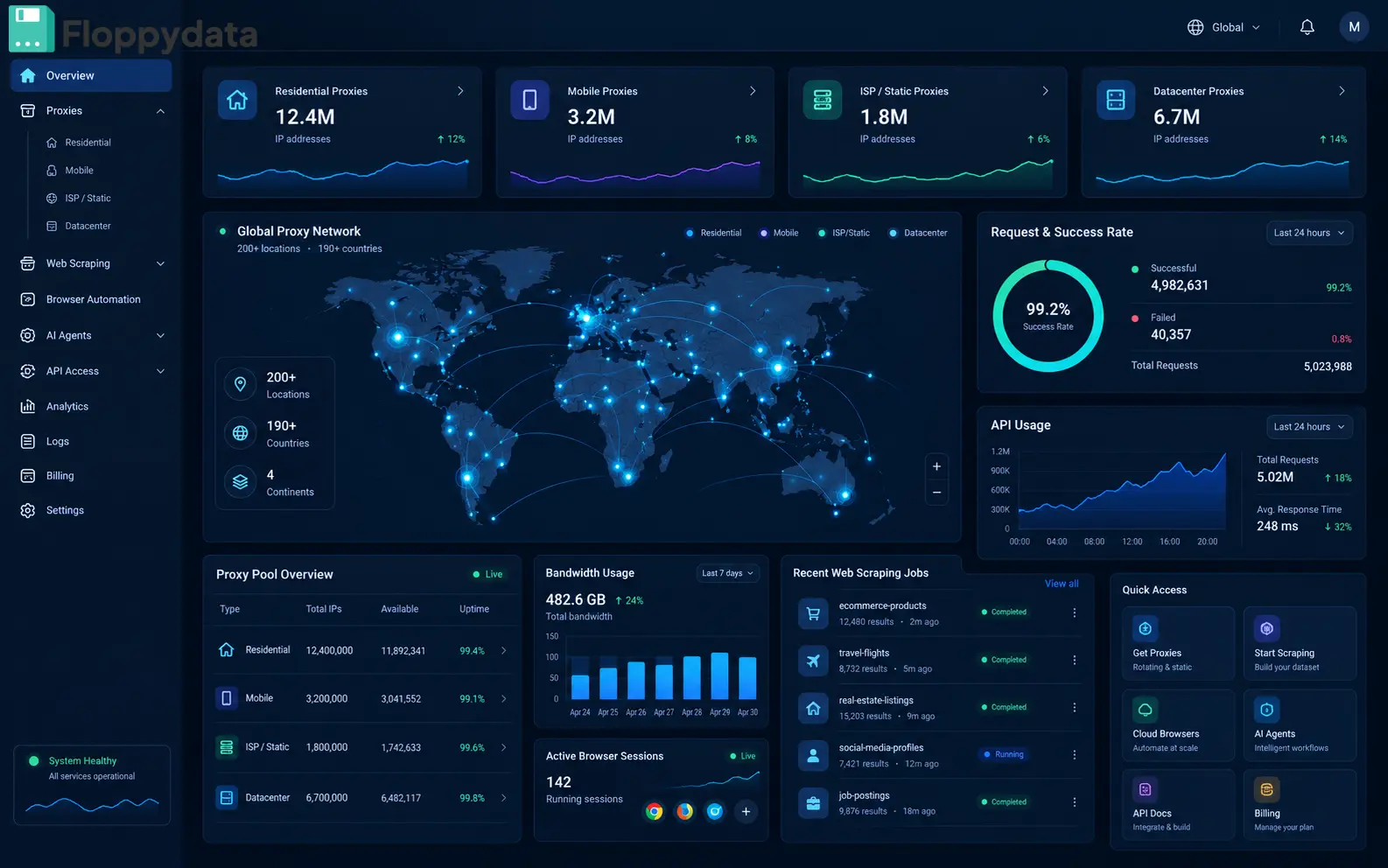
- One $1/GB rotating balance usable as residential, mobile (3G to 5G), or datacenter traffic
- 1M+ residential IPs · 195+ countries · country, state, city, ASN and IP-type targeting
- Single static IP for $19 (4-month term), or bundles from $1.79/IP (ISP) and $0.79/IP (datacenter) with unlimited bandwidth
- HTTP, HTTPS, SOCKS5 and UDP (beta) · free anti-detect Cloud Browser · Web Scraper from $0.89 per 1K successful scrapes
- Scraping teams that start on datacenter and switch to residential only for blocked targets
- Social and app-testing work that needs mobile IPs without mobile-proxy pricing
- AI agents and RAG pipelines using the fetch API or the CDP-driven Cloud Browser
- Agencies wanting proxies, static IPs, and a scraper under one API key
- Flat $1/GB from the 19GB / $19 starter, so a test costs what production costs
- Mobile traffic at the same $1/GB as residential, far below typical mobile rates
- Cloud Browser free for proxy users; Web Scraper bills only successful pages
- Visa, Mastercard, Amex, PayPal, 70+ cryptocurrencies or an auto-renewing wallet · 24/7 email and Telegram support
- 1M+ residential pool is far smaller than the 28M to 150M pools in this list
- No volume discount on rotating GBs: large orders still cost $1/GB
- No public IP-sourcing page; SOC 2, CCPA and GDPR badges aren’t linked to reports
| Plan | Price | Per GB | Trial |
|---|---|---|---|
| Rotating Starter (19 GB) ⭐ | $19.00 | $1.00/GB | Free start |
| Rotating (any larger size) | $1.00/GB | $1.00/GB | — |
| Single Static IP | $19.00 | 4-month term | — |
| Static Datacenter (100 IPs) | $79.00/mo | $0.79/IP · unlimited | — |
| Static ISP (100 IPs) | $179.00/mo | $1.79/IP · unlimited | — |
Test Results
Floppydata joined this list in October 2026, after the February to April test window had closed, so the numbers in this block are Floppydata’s published figures, not my measurements: under 0.3 seconds average response, 99.99% uptime, a 95% clean-IP rate, and a 99.9% success rate on its Web Scraper. The 95% clean-IP figure is the one I’d plan around. It implies roughly 1 IP in 20 may already carry a bad reputation, so build retries into any Amazon or LinkedIn job from day one. Pool size is the other number to weigh: at city or ASN level in smaller markets, 1M+ residential IPs will cycle back to repeat addresses sooner than IPRoyal’s 32M+ or Decodo’s 115M+ pools. Floppydata goes through the same Playwright and Scrapy run from the Frankfurt VPS in the next benchmark update, and its scores will be revised against measured data.
Personal Experience
What earned Floppydata a spot here is the billing model. Every other provider in this list sells residential, mobile, and datacenter as separate plans. Floppydata sells one balance at $1/GB and lets you spend it as any of the three, switching whenever you like. In practice you can run a Google SERP job on cheap datacenter routing, move the Amazon part to residential, and push Instagram account checks through mobile IPs, all billed against the same 19GB starter. Mobile at $1/GB is the standout, since dedicated mobile providers usually charge several times that. The extras are useful too: the Cloud Browser is a managed anti-detect Chromium you drive with Playwright or Puppeteer over CDP, free for proxy customers, and the Web Scraper takes one POST with a URL and a country code and bills only for pages that come back.
On paper, the limits are just as clear. The flat rate cuts both ways: there’s no volume discount, so at 200GB and above Proxy-Seller ($0.70/GB at 500GB) and DataImpulse ($0.80/GB at 200GB) undercut it. Static IPs are no longer the issue they were: a single static IP now costs $19 for a 4-month term, so a buyer who needs three fixed addresses doesn’t have to buy a 20-IP bundle. And I couldn’t find a public IP-sourcing page, which matters given the botnet issue covered earlier in this guide. Ask support how the residential pool is sourced before you route anything sensitive through it.
Bottom Line: Floppydata is the flexible budget pick of 2026: one $1/GB balance across residential, mobile, and datacenter traffic, static IPs from $0.79, and a free Cloud Browser make it a strong second provider or a first account for small teams, as long as you test your target geo on the 19GB starter first.
How Do the Top 7 Residential Proxies (and Floppydata) Compare Head-to-Head?
The table below condenses six weeks of testing into the metrics that actually determine production performance: success rate on hard targets, average latency, IP pool breadth, and pricing. Sort by your primary KPI to make the pick obvious. Floppydata’s column uses vendor-published figures (marked *) until it completes the same test run.
| Proxy-Seller Top | IPRoyal | Live Proxies | Decodo | Bright Data | DataImpulse | ProxyLane | Floppydata | |
|---|---|---|---|---|---|---|---|---|
| Success Rate | 97.3% | 96.8% | 97.5% | 97.6% | 98.4% | 95.2% | 96.4% | 95% clean* |
| Avg Latency | 142ms | 168ms | 128ms | 112ms | 127ms | 198ms | ~350ms | <300ms* |
| IP Pool Size | ISP-direct | 32M+ | 10M+ private | 115M+ | 150M+ | Self-sourced | 28M+ clean | 1M+ res. |
| Entry Price/GB | $0.70 | $1.75 | $2.00 (B2B) | $4.00 | $8.40 | $1.00 | $6.50 → $2/GB | $1.00 flat |
| Free Trial | ✓ | ✓ | B2B only | ✓ | ✓ | ✓ | ✓ | ✓ |
| Sticky Sessions | ✓ | ✓ | ✓ | ✓ | ✓ | ✓ | ✓ | ✓ |
| Crypto Pay | ✓ | ✓ | ✗ | ✓ | Partial | ✓ | ✓ | ✓ |
| Overall Score | 9.4 ⭐ | 9.1 | 8.9 | 8.8 | 8.7 | 8.5 | 8.3 | 8.2 |
Benchmark Results — Visual Breakdown
52,400 total requests across 7 providers, tested February 14 – April 8, 2026. Charts show raw performance data from the Frankfurt VPS test environment. Floppydata, added October 2026, appears with vendor-published figures marked *.
Which Type of Residential Proxy Actually Fits Your Use Case?
Residential proxies are not a monolithic category. The four main types differ meaningfully in trust level, session behaviour, price, and target site compatibility. Choosing the wrong type is one of the most expensive mistakes I see in new scraping setups.
Frequently Asked Questions About Residential Proxies
All benchmark data in this article was collected between February 14 and April 8, 2026. I used Playwright v1.44 and Scrapy 2.11 as primary request tools, running from a dedicated Ubuntu 22.04 VPS (4-core, 8GB RAM) hosted in Frankfurt, Germany. Each provider received a minimum of 5,000 requests, with Proxy-Seller, IPRoyal, Live Proxies, and Bright Data receiving 7,200–9,600 requests each. Target sites were Amazon.com, Amazon.co.uk, Amazon.de, LinkedIn.com (Sales Navigator), Google.com/search, G2.com, Booking.com, and Reddit.com. A request was counted as “successful” only if the target content loaded with the expected response structure — not just a 200 HTTP status code. CAPTCHAs and soft-blocks were recorded separately. I have affiliate relationships with Proxy-Seller, IPRoyal, Live Proxies, and ProxyLane — affiliate links are marked with ↗ and do not affect rankings. DataImpulse and Bright Data have no affiliate arrangement with ProxyAdvice.net at time of publication. Floppydata was added on October 1, 2026, after this test window closed, and its pricing, protocol, and payment details were updated on October 8, 2026 with information confirmed by Floppydata; its entry uses vendor-published figures and will be re-scored after the next benchmark run. Links to Floppydata are marked ↗ and may earn a commission.