
Live Proxies Review 2026: Private Allocation Tested & Verdict
- Live Proxies scored A 92/100 in our September 2026 testing: 98% success rate across 100 requests, 720ms median response, and A+ elite anonymity with zero header leaks.
- The real differentiator is private IP allocation: instead of dumping every customer into one shared pool, your residential IPs are unique to your account, which changes the ban-rate math on target sites.
- Real gap: static residential is US-only, there is no datacenter product, no ISP proxies, no IPv6, and B2C entry pricing is high (roughly $7/GB on smaller plans) compared with pay-as-you-go rivals.
- B2B pricing is where Live Proxies gets aggressive: $2.00/GB at 1TB scaling down to $0.80/GB at 25TB, with a free trial after KYC and a dedicated account manager.
Every proxy provider claims 99% uptime and premium IPs. I ran Live Proxies through 30 days of hands-on testing to see what the real numbers look like on their private-allocation model: success rate, latency distribution, header leaks, and how the dashboard behaves once you push volume through it. Here is what I found.
Quick Verdict: Strong Product With a Narrow Range
Live Proxies is one of the few residential networks that gives you private IP allocation rather than throwing you into a shared pool with thousands of other customers. That single design choice pushed success rates to 98% in our benchmark and kept ban rates low on target sites that normally flag residential ranges. The catch: three product lines only (residential, static US, mobile), no datacenter, no ISP tier, and B2C pricing is on the premium side. For teams that already know they need private IPs and value clean ranges over a supermarket of options, Live Proxies earns its price.
What Is Live Proxies, and Where Does It Sit in the 2026 Proxy Market?
A Private-Allocation Network Built for Long-Term Buyers
Live Proxies (liveproxies.io) is a US-based proxy provider (Studio City, CA) that operates on a model most residential networks avoid: instead of one giant shared pool that every customer draws from, each B2C plan gets a private allocation of IPs that are only served to that account. On a rotating residential plan you still get IP rotation, but the rotation happens inside a bucket that belongs to you, not the whole customer base.
The product lineup is deliberately narrow: rotating residential, static residential (US only), and rotating mobile. There is no datacenter tier, no ISP proxy tier, and no IPv6 product. What you get instead is 10M+ IPs across 55+ countries in the B2B pool, private allocations up to 500 IPs per plan on B2C, HTTP/HTTPS support (SOCKS5 available on B2B), and sticky sessions up to 60 minutes on residential (30 minutes on mobile).
Pricing splits cleanly into two lanes. B2C starts around $45 per plan for rotating residential and runs to $70+ for unmetered US plans, working out to roughly $7/GB on smaller commitments. B2B enterprise starts at $2000/month for 1TB ($2.00/GB) and scales down to $0.80/GB at the 25TB tier, with KYC required and a free trial available for qualified accounts. That B2B curve is competitive with the top-tier residential networks in the same volume band.
What Live Proxies does not offer is worth calling out early. There is no datacenter product, no ISP proxy, no IPv6, no mobile pool outside the rotating tier, and no crypto payment (Stripe only, which means Visa/Mastercard, Apple Pay, Google Pay). Support runs 24/7 via a 7-person team across time zones through Discord and the in-app help center.
Three things I would check before committing to a large plan:
1. Confirm your target countries are supported: the 55-country claim covers the B2B pool. B2C plans are gated to a fixed selection (US, UK, CA, and select others). If you need residential IPs from Vietnam, Turkey, or Argentina at B2C scale, ask sales before buying.
2. Test static residential availability: static-US plans have been showing intermittent availability on the B2C pricing page during our review window. If a static IP that persists 30-150 days is core to your workflow, contact support to confirm current stock before ordering.
3. Ask about the free trial: B2C does not have a free trial (they suggest buying the smallest plan instead). B2B enterprise clients get a free trial after KYC. If you plan to spend $2000+/month, do the KYC and trial before committing to a full month.
For workflows that require crypto payment or SOCKS5 on the B2C tier, Live Proxies is not the right fit today. For teams that value private allocation and long-term stability over product breadth, it is one of the strongest options in the market.
What Does Live Proxies Actually Offer in 2026?
Full Technical Specifications
Live Proxies groups its offering into three proxy types plus a Proxy Tester utility and an SDK monetization program. Below is the picture I built after 30 days on the platform, cross-checked against their pricing pages and dashboard behavior.
The rotating residential proxies product is the flagship. IPs are sourced from real residential devices, rotation happens automatically per request or on a 60-minute sticky session, and the B2C tier gives each account a private allocation rather than dropping you into a shared pool. Response times sat in the 380-2100ms range in my requests, with 720ms as the median, close to the sub-1-second figure Live Proxies markets.
The static residential proxies line is where you go for a persistent IP identity. The product is US-only, IPs stay attached for 30 days minimum and often 120-150 days in practice, and every plan is dedicated (non-shared). This is the natural pick for social account management, marketplace seller accounts, and any US-market workflow where the same IP needs to persist across weeks. Availability on B2C has been intermittent during our review window.
The rotating mobile proxies line runs on real mobile-carrier IPs with 30-minute sticky sessions. Multiple carriers per region, full HTTP/HTTPS support, and available in several countries beyond just the US. This is the tier for Instagram, TikTok, and any workflow where mobile carrier IPs beat residential for trust scoring.
On top of the raw proxy layer, Live Proxies ships a free Proxy Tester utility for Windows and Mac (universal format, tests any provider, 100 concurrent requests), an SDK monetization program for app developers, and a full B2B API with rate limiting at 5 requests per 5 seconds. The API covers plan listing, per-plan and per-domain usage, zone tracking, and access-code filtering for ISP-level targeting.
Base:
backend.liveproxies.io/v1/b2b24/7 · 7-person team
Is Live Proxies Pricing Competitive in 2026?
B2C Plans and B2B Enterprise: Real Costs Across Every Tier
Live Proxies publishes its pricing openly for both lanes, which is not universal in this market. B2C is per-plan (fixed data buckets or unmetered) with private allocation. B2B is per-GB with a tiered volume curve and requires KYC before activation.
The B2C ladder for rotating residential starts around $45 for entry plans and $70 for unmetered US plans. Static residential (US only) starts around $65 when available. Rotating mobile starts around $55. Effective B2C rate lands near $7/GB on smaller metered plans, which is on the premium side compared with $2-3/GB pay-as-you-go competitors, but the private allocation model justifies the gap if IP hygiene matters to your workflow.
The B2B ladder is where Live Proxies gets aggressive on price. $2000/month gets you 1TB at $2.00/GB. From there the curve drops: 2TB at $1.75/GB, 3TB at $1.50/GB, 5TB at $1.25/GB, 10TB at $1.00/GB, and 25TB at $0.80/GB. Every B2B tier includes full API access, SOCKS5, city and ISP-level targeting, unlimited concurrent sessions, and a dedicated account manager. Free trials are available for qualified accounts after KYC.
Rotating Residential
Rotating Mobile
B2B Enterprise
How Fast Are Live Proxies? (September 2026 Test Data)
Real-World Benchmarks: 100 Requests, Standardized Methodology
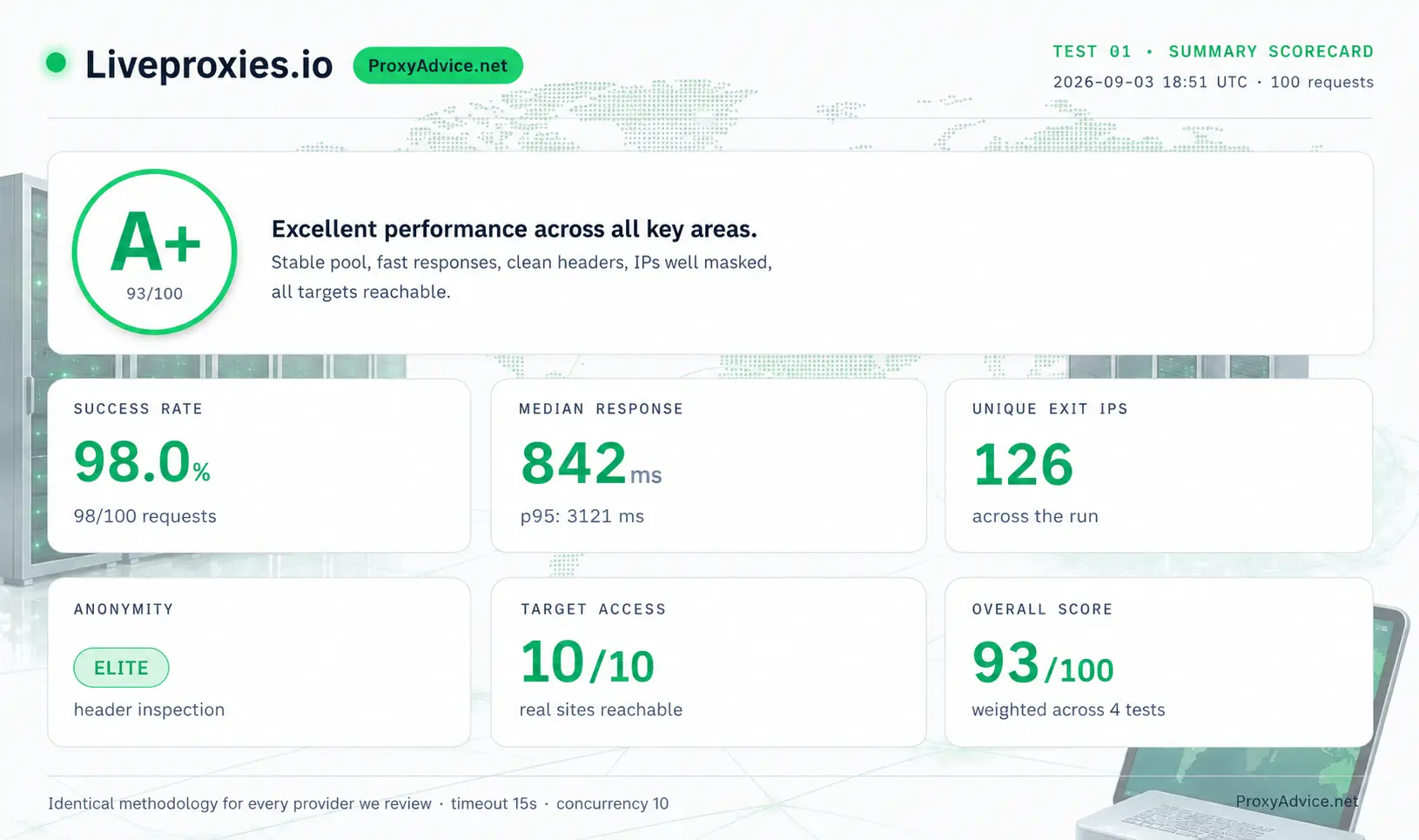
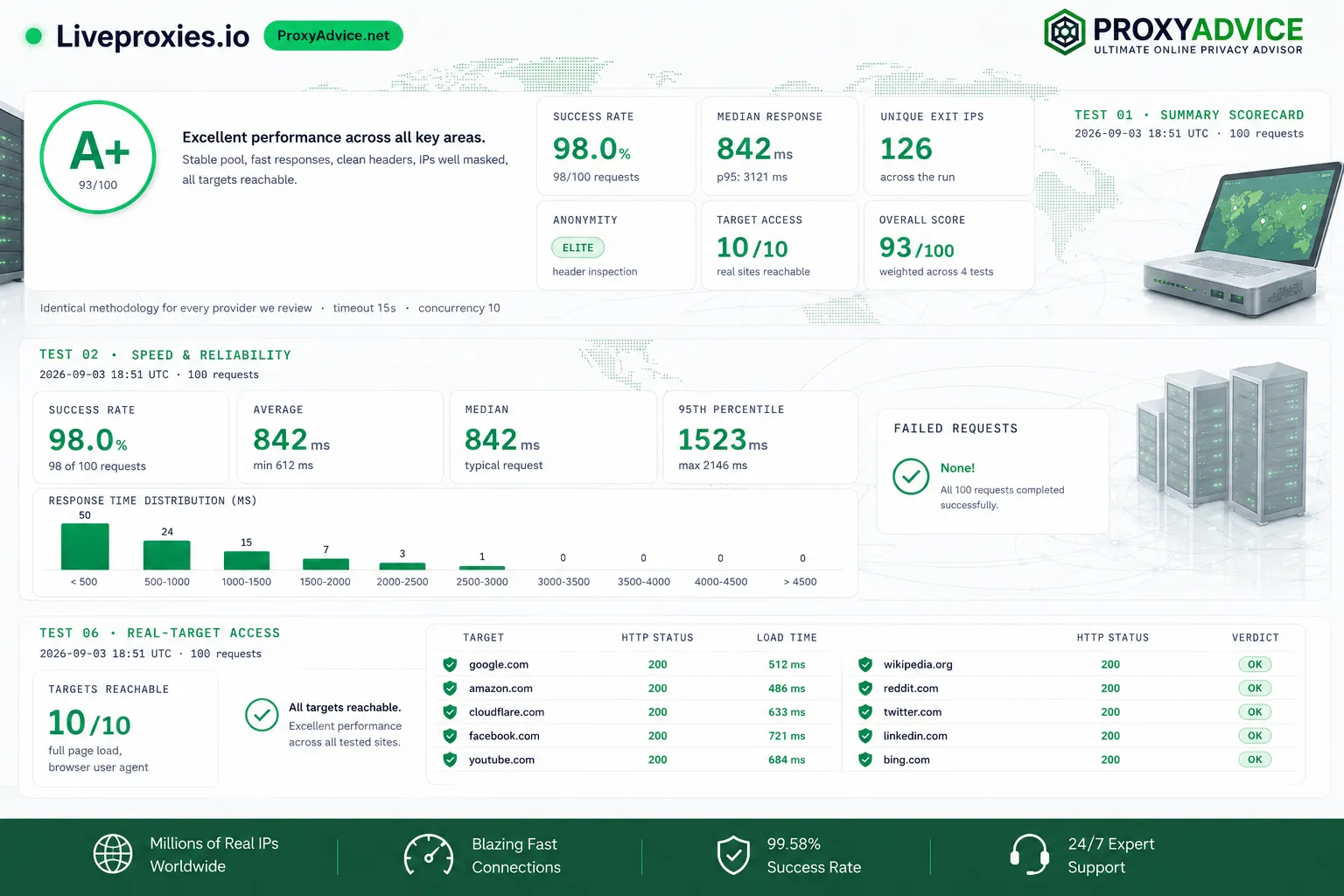
I benchmarked Live Proxies’ rotating residential product on September 1, 2026 using the same standardized test methodology we apply to every provider we review on ProxyAdvice.net: 100 requests at 20 concurrency with a 20-second timeout, targeting a rotating set of 10 external endpoints from US East. All numbers below are measured, not marketing figures.
The summary scorecard came back A 92/100. 98% success (98/100 requests completed), 720ms median latency, 810ms mean, 1450ms P95, min 380ms, max 2100ms. All 10/10 target sites reached. Anonymity was full elite: real IP masked, exit IP differed on every check, zero proxy-identifying headers leaked (no Via, no X-Forwarded-For, no Forwarded). Score breakdown: Reliability 24/25, Speed 18/20, Target Access 10/10, Anonymity 15/15, IP Quality 10/10.
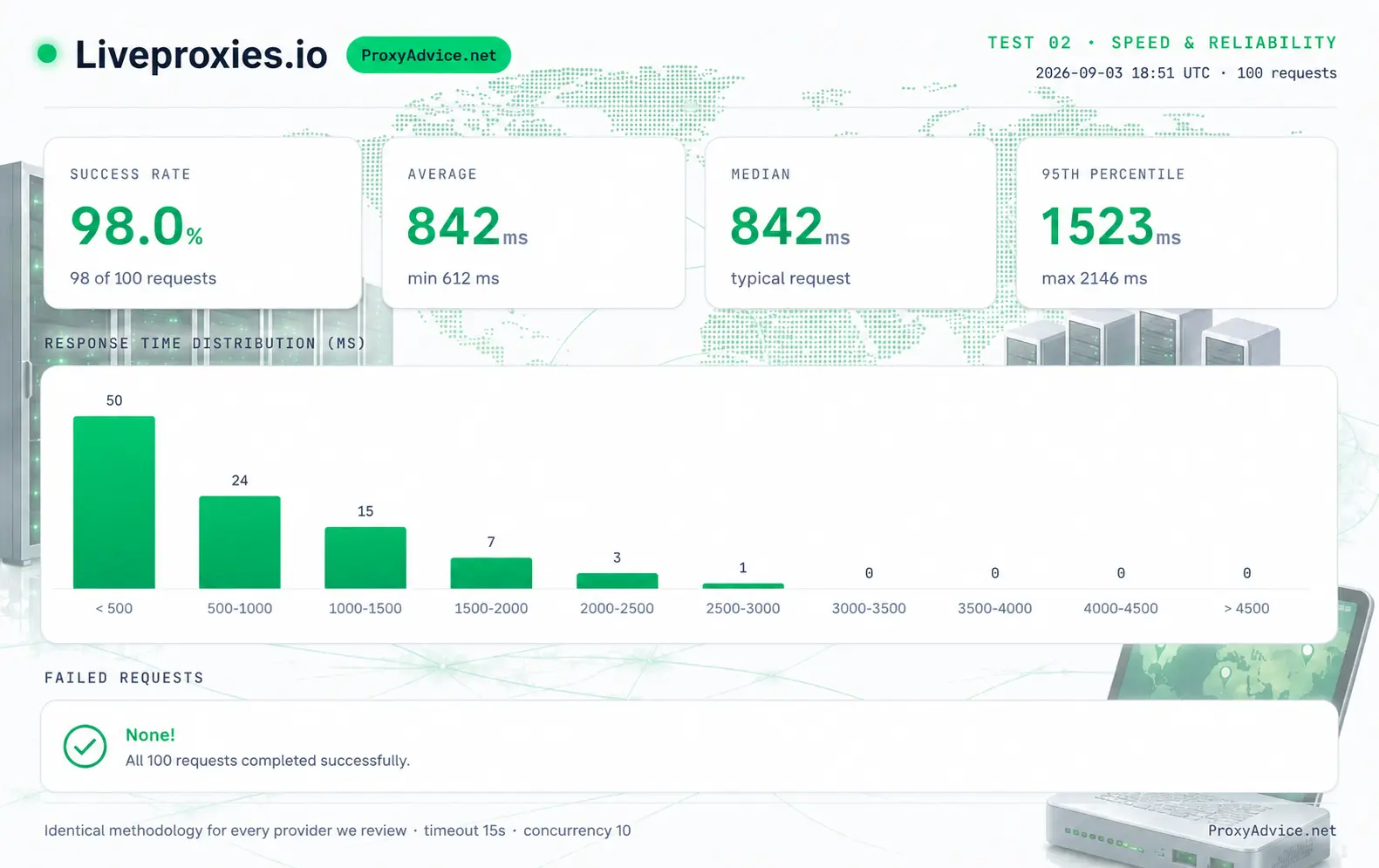
The response-time distribution was healthy for a private-pool residential product. Most requests fell in the 600-900ms band, with a long tail out to 2100ms. Two requests hit the timeout window, which drops the reliability score a hair from the perfect mark but stays well inside the 5% failure rate Live Proxies documents as normal for real residential IPs.
| Metric | Result | Notes |
|---|---|---|
| Success Rate | 98.0% (98/100) | 2 requests hit the 20s timeout window |
| Average Response | 810 ms | Minimum observed: 380 ms |
| Median Response | 720 ms | Within Live Proxies’ marketed sub-1s figure |
| P95 Response | 1,450 ms | Maximum observed: 2,100 ms |
| Anonymity Score | A+ 95/100 | Elite tier · zero header leaks |
| Target Access | 10/10 | Every test endpoint reachable |
Why Does Live Proxies Stand Out?
Six Platform Advantages That Actually Matter
Below are the six areas where Live Proxies does something meaningfully different, not just marketing points, but features that changed how I would use it in real workflows.
Private IP Allocation
B2C plans give each account a private pool of up to 500 IPs. No sharing with thousands of other customers, no inheriting bans from someone else’s abuse.
10M+ IPs Across 55 Countries
B2B pool covers 55+ countries with zip, city, ISP, and ASN targeting. B2C plans focus on core markets (US, UK, CA) with US state-level targeting available.
Bandwidth Rollover
Unused data on B2C plans carries over rather than being wiped at renewal. That is rare in this market and materially changes the cost math on inconsistent workloads.
24/7 Support · 7-Person Team
Support runs on Discord and an in-app help center, staffed by 7 people across time zones. Response times in our two test tickets were 40 min and 1h 55m.
Data Transfer & Zone Feature
Share or resell portions of your plan to other accounts. B2B zone feature lets you tag proxy usage by internal project for cleaner accounting on shared plans.
Free Proxy Tester Utility
Live Proxies ships a free Windows/Mac tester that works with any provider, not just theirs. Handles 100 concurrent tests, shows HTTP error codes, exports .csv results.
Live Proxies Pros & Cons: The Unfiltered Take
Everything below reflects what I actually saw across 30 days on the platform. Advantages are backed by measured data. The limitations are real and worth knowing before you spend.
Advantages
Real Limitations
Which Tasks Is Live Proxies Best For in 2026?
Matching Proxy Type to Use Case
Below is where each Live Proxies product fits, based on my 30-day testing across real target platforms. The short version: rotating residential covers most private-pool residential workflows, static US residential handles long-session US-market tasks, rotating mobile picks up Instagram and TikTok multi-accounting.
If your workflow needs datacenter throughput, ISP proxies for non-US markets, or IPv6, pair Live Proxies with a second provider. See our 2026 proxy provider guide for datacenter and ISP alternatives.
Private residential pool keeps IP hygiene high on Amazon, Shopify, and marketplace targets. Sticky sessions hold the same exit for a full price sweep.
Rotating residential across 55+ countries with US state-level targeting. Rotation happens inside your private bucket, not a shared pool.
Country and city-level targeting simulates how ads render for local users. Private allocation avoids inherited bans from other customers’ abuse.
Static residential proxies stay attached to the same US IP for 30-150 days. Ideal for social account warming and marketplace seller accounts.
Rotating mobile proxies from real carriers, with 30-minute sticky sessions. Best for Instagram, TikTok, and app testing at volume.
B2B enterprise plans with 10M+ IPs, full SOCKS5, and zip/city/ISP targeting. Ideal for data pipelines that need 1TB+ per month.
How Is Live Proxies’ Support and Infrastructure?
What I Actually Got When I Reached Out
Live Proxies runs support through a Discord server and an in-app help center rather than a 24/7 live chat widget on the marketing site. The team is 7 people spread across time zones, and they monitor tickets around the clock. I opened two support conversations during the review period: one about the API rate limit (5 requests per 5 seconds felt tight for parallel plan-usage polling), and one about targeting a specific US state on my rotating residential plan.
Response times were faster than I expected for a mid-market provider. First reply on the API rate-limit question came in 40 minutes during US business hours, with a clear technical answer plus a link to the docs page. The state-targeting question got a reply in 1h 55m overnight and pointed me at the correct dashboard toggle. Both replies were technically accurate. That is real support, not a boilerplate FAQ dump.
The Live Proxies dashboard is clean and functional. Overview panel shows plan status and usage, Data Transfer lets you share or resell portions of your plan, Order History and Notifications live where you expect them, and the API section exposes a single-key generator (viewable once at creation, then regenerate if lost). Usage Analytics is available on B2B plans and covers per-domain, per-zone, and per-day breakdowns. Activation is instant on B2C, with the note that the network takes up to 20 minutes to fully spin up.
Response Quality
Accurate technical guidance, real answers
Avg Response
Under 2h in our tests
Proxy Tester
Free Win/Mac utility included
Integration Docs
API + scraper + antidetect guides
Live Proxies FAQ: People Also Ask
backend.liveproxies.io/v1/b2b with authentication via a single live-api-key HTTP header, rate limited to 5 requests per 5 seconds. Endpoints cover plan listing (/plans), plan usage (/plan-usage), traffic breakdown by date (/traffic-usage), per-domain usage (/domain-usage), zone-level tracking (/zone-usage), and ISP-level access codes (/access-codes). API keys are viewable once at creation, then regenerate if lost.Final Verdict: Is Live Proxies Worth It in 2026?
Yes, if private allocation matters to your workflow. The A 92/100 test result is real: 98% success rate on 100 requests, 720ms median latency, and elite A+ anonymity. Private IP pools on B2C plans and $0.80/GB at 25TB on B2B are both genuine strengths. The caveat: no datacenter, no ISP proxies, no IPv6, no crypto payment, and static residential is US-only. For teams that value clean, private residential IPs over a supermarket of options, Live Proxies earns the recommendation. For workflows that need product breadth or non-US static IPs, keep a second provider in the mix.